soul-test-netflow: three thermal-fluid paradigms on one PWR pin
The same nuclear-reactor pin / coolant-loop physics, built three different ways on one machine — by-hand Python, Julia's ModelingToolkit, and Modelica/Dymola. The comparison across the three is the deliverable.
Archived·since — views
What it is. One physics problem — a uranium-oxide fuel pin, its helium gap, its cladding, and the high-pressure water flowing past it — solved three times on the same machine. Each version uses only the standard-library tools its language ecosystem ships with: no third-party domain libraries, no tuned commercial extensions.
Why. A quick exploration to find out when different tool’s performance hits a wall - python, Modelica/Dymola, Julia-MTX. The simulation isn’t the deliverable; the comparison is.
The three legs
python/— netflow. A solver built from scratch in Python. The model is a graph: a value sits on each node, a flux flows along each edge. Sparse linear algebra (scipy.sparse) plus a damped Newton iteration. CoolProp’s water property tables. ~1342 lines of code.julia-mtk/— soultest-julia. The same physics on Julia’s ModelingToolkit (MTK) — an acausal-symbolic modeling library, similar in spirit to Modelica. Uses MTK’s standard component library, but had to hand-roll a fluid-flow connector (the library doesn’t ship one yet) and use a constant specific-heat approximation for water (no IF97 water properties available for MTK). 98 lines of code.modelica/— soultest-modelica. The same physics in Modelica 4.1 on Dymola 2026x, the mature commercial simulator. Uses the Modelica Standard Library (MSL) for thermal and fluid connections, and MSL’s built-in IF97 steam-tables water. Driven headlessly from Python. 430 lines of code.
Headline
| Axis | Python (netflow) | Julia / MTK | Modelica / Dymola |
|---|---|---|---|
| Solve one fuel pin | 9 ms (just the math) | 0.064 s at 10,000-cell mesh | 3.7 s (includes translate + compile + run) |
| Match to netflow’s baseline temperature | reference | 25 mK (with matched water properties) | 24.7 mK matched / 0.34 K with default properties |
| Lines of code | ~1342 | 98 | 430 |
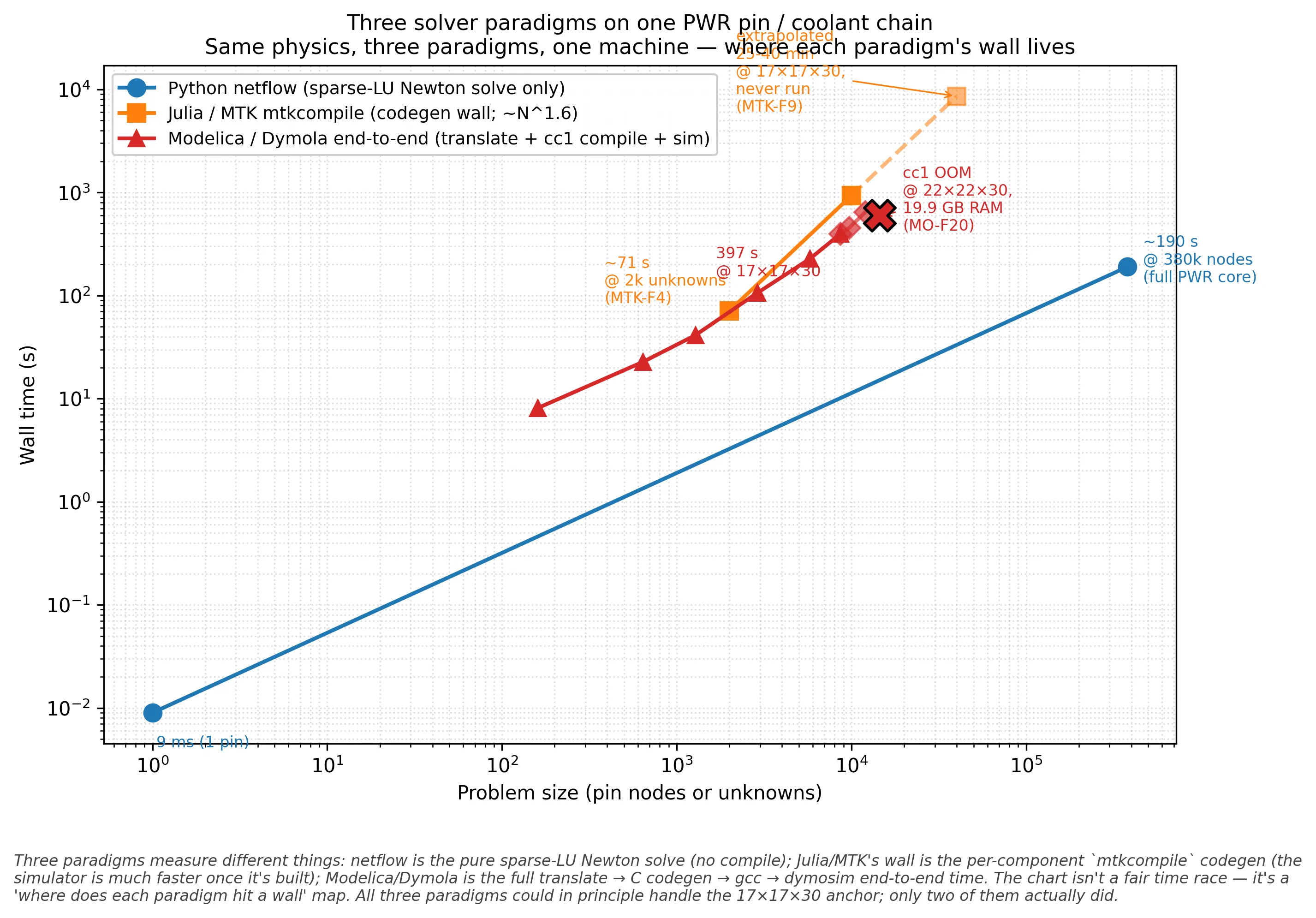
| Full 17×17 PWR fuel assembly | reachable (~190 s) | never ran — extrapolated 25–40 min just to compile | 397 s end-to-end, completed |
| Where each one hits a wall | sparse linear solve around a million nodes | MTK’s compile step scales as ~N^1.6 | C compiler chews through ~174 MB of generated source for ~5 min |
Reading order
Four posts walk the same arc:
- The Python prototype — building the abstraction by hand.
- The Julia/MTK rebuild — same physics, 14× less code, then a compile wall.
- The Modelica leg — the same physics on a mature ecosystem, including the full PWR assembly Julia couldn’t reach.
- The comparison — same physics, three walls. The claim is that the walls trace to ecosystem gaps, not to the paradigm itself.
The repo’s modelica/docs/COMPARISON.md
is the depth artifact (full cross-leg table + scaling stories); each leg also
carries its own CLOSEOUT.md and FINDINGS.md.
Honest caveats
- One person, one machine, one week. No claim that the numbers generalize to other hardware.
- Code-comparison, not validation. Each leg’s strongest claim is “matches another solver to X mK” or “matches a known closed-form answer.” None of these were tested against measured reactor data — that data is restricted to full-core safety analyses we don’t have access to.
- The time-axis isn’t a race. Python’s 9 ms is just the math; Dymola’s 397 s includes translating the model, compiling C code, and running the simulator. The interesting axis is was the problem reachable at all, and did the bottleneck shift the way the comparison predicted.
Writing about this
The third episode of soul-test-netflow — Modelica 4.1 running in Dymola, the mature commercial simulator. The 17×17 PWR fuel assembly that Julia could only extrapolate, completed in 397 seconds end-to-end.
The capstone of soul-test-netflow — same nuclear-reactor pin physics, three different software stacks. Each one hit a wall at a different scale. The claim worth staking is that the walls are ecosystem-shaped, not paradigm-shaped.
The first of three episodes in soul-test-netflow — a domain-agnostic "conservation on a network" solver in pure Python, with nuclear thermal-hydraulics as its first plugin.
The Julia / MTK episode of soul-test-netflow — same physics as the Python netflow, on a high-level symbolic modeling library. Matched node-by-node to 25 mK with 14× less code, and stopped short of a full reactor-assembly model when the compile step became the bottleneck.