Three walls, one paradigm: the bottlenecks are ecosystem gaps, not the math
·Essay·5 min read— views
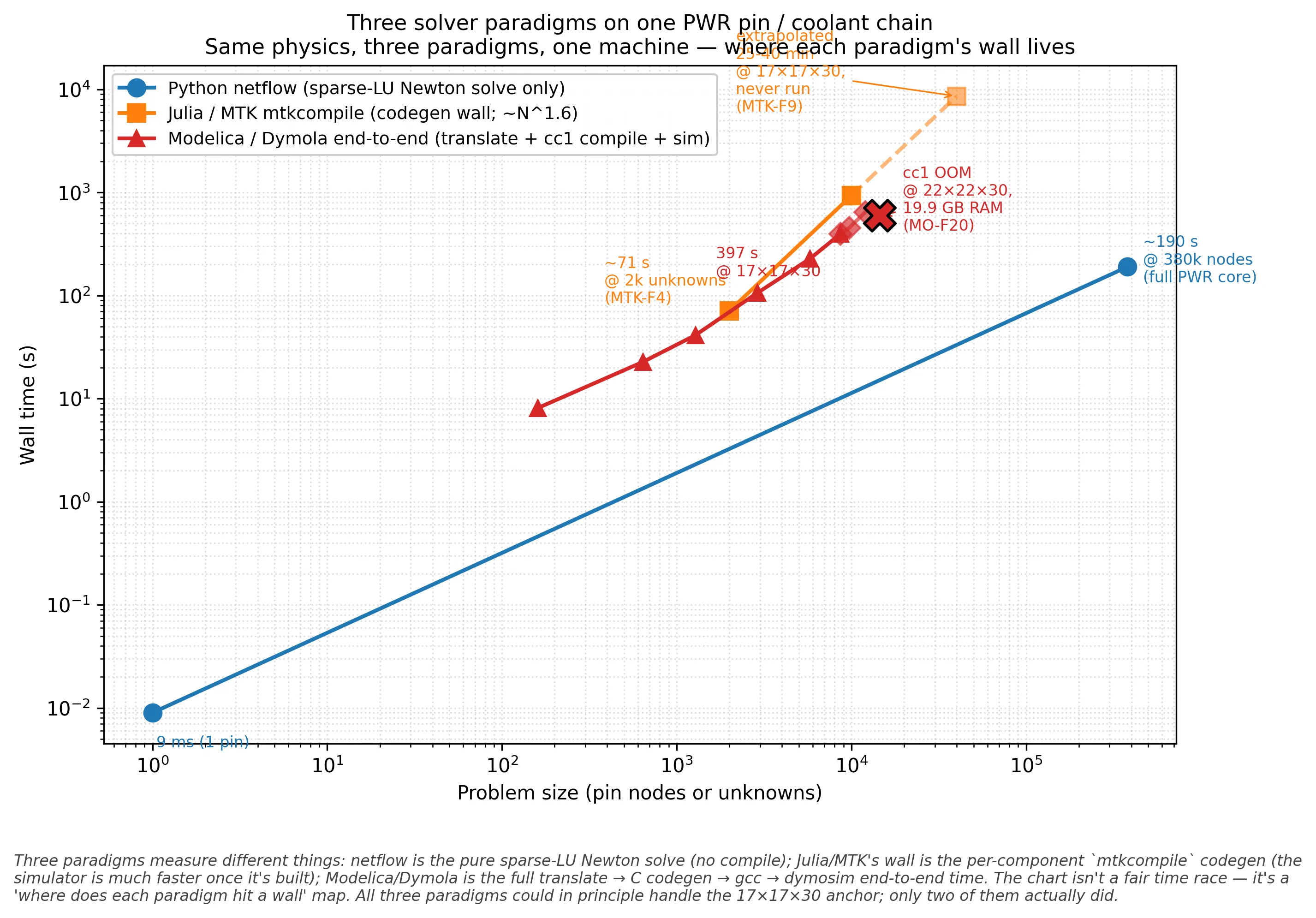
The claim. Same physics, three machines, three walls — and the walls are ecosystem gaps, not paradigm failures. The “symbolic-modeling” approach itself (where you describe components as equations and let a library generate the simulator) held up everywhere it was tested. What differed was which standard-library piece each ecosystem hadn’t shipped yet.
This is the capstone of soul-test-netflow: one bounded thermal-fluid problem (a fuel pin, its helium gap, its cladding, and the high-pressure water flowing past it, at ten progressively harder problem sizes) built three times in Python, Julia/ModelingToolkit, and Modelica/Dymola, on the same machine, in the same week, from each ecosystem’s standard library only.
The floor: same equations, same numbers
Before any wall talk, the agreement floor — how closely the three legs agreed on the same physics:
| Comparison | Match to Python netflow’s baseline temperature |
|---|---|
| Julia / MTK vs Python | 25 mK (with matched water-property tables) |
| Modelica / Dymola vs Python | 24.7 mK (matched properties) · 0.34 K (each leg using its default water model) |
| Modelica vs Julia (small problems) | same equations, same numbers, same debugging experience |
At small problem sizes the two symbolic-modeling legs are reading the same physics through different simulators and producing the same answer to the digit. The paradigm itself is portable.
The three walls
| Stack | Where the wall lives | Number |
|---|---|---|
| Python (netflow) | sparse linear solver around a million unknowns | 380k unknowns in ~190 s; bigger is slower, not blocked |
| Julia / ModelingToolkit | the compile step that turns the model into one large generated function | ~71 s to compile alone at 2,000 unknowns; a full 17×17 PWR fuel assembly was extrapolated at 25–40 minutes and never run |
| Modelica / Dymola | the C compiler (gcc) chewing through generated source or an initialization-phase solver |
17×17 assembly in 397 s end-to-end; a 22×22 grid ran the machine out of RAM — the compile step alone hit ~19.9 GB |
Each wall is at a different scale, and each is a different kind of cost.
Why “ecosystem, not paradigm”
The Julia / MTK case is the load-bearing one, so it goes first.
Julia / MTK — every wall traces to a missing piece, not to the math.
- The compile step scales badly (~N^1.6 in the number of unknowns) because the open-source pipeline expands every component into its own block of code. A commercial tuned compiler called JuliaSimCompiler.jl is known to flatten this — but it’s gated behind a paid registry and was out of scope for a standard-library comparison. With it, the wall plausibly moves a long way.
- The Julia version had to fake water with a constant specific-heat approximation because no industry-standard steam-table library (IAPWS-IF97) exists for MTK. The 25 mK match to Python required manually fitting a quadratic over the coolant temperature range — a workaround for a missing library, not a paradigm limit.
- The Julia version hand-rolled a fluid-flow connector because MTK’s standard library doesn’t ship one. Modelica’s standard library handles the same case directly.
None of those say “the symbolic-modeling paradigm doesn’t work.” All three say “the Julia ecosystem hasn’t shipped the piece yet.”
Modelica / Dymola — the wall is real but partly paradigm-shaped, and the post is honest about that.
- A 17×17 assembly fits in 397 seconds. A 22×22 doesn’t, because the C compiler had allocated about 19.9 GB of RAM on 174 MB of generated source before being killed. No Dymola setting moves this — mitigation would need a smaller/faster C compiler.
- The initialization-phase wall does respond to ecosystem knobs: turning on Dymola’s sparse-linear-algebra mode rescues a chain that simply fails at default settings (a 5,000-element case: failed → 228 seconds). That one is the simulator’s choice, not the underlying math.
This is where the claim is honest about its edge: the C-compiler RAM ceiling really is a paradigm × toolchain interaction, not a pure ecosystem gap. Symbolic models emit large blocks of generated C; large C costs RAM to compile. Mitigation paths exist (sparser code generation, lighter-weight C compilers, partial compilation) but they aren’t one missing library.
Python (netflow) — the wall is the design choice, by definition.
When you hand-roll the solver, the wall is whatever tool you picked.
scipy.sparse plus a Newton iteration tops out around a million unknowns.
That isn’t an indictment of Python; it’s the cost of opting out of an
ecosystem’s bigger machinery in the first place.
What this is not
- Not a winner. Python’s 9 ms vs Dymola’s 397 s is a category error — one is pure math, the other is translating the model + compiling C + running the simulator. The interesting axis is was the problem reachable at all, and did the bottleneck shift the way the comparison predicted.
- Not validation. Every comparison here is code-against-code or code-against-a-known-closed-form. None of these were tested against measured reactor data — that data is restricted to full-core safety analyses I don’t have access to.
- Not generalizable past one machine. WSL2 on Linux 6.6, Dymola 2026x, MTK on Julia 1.11, Python 3.12. One person, one week.
Source of truth
The depth artifact is the repo’s
modelica/docs/COMPARISON.md
(full cross-leg table, scaling stories, per-leg findings). The umbrella
project page is soul-test-netflow.
If a number reads wrong, the repo invites correction — none of these is meant to be the final word.