Rebuilding netflow on ModelingToolkit: 14× less code, then a compile wall
·Devlog·2 min read— views
What it is. The same fuel-pin → coolant-loop physics as the Python episode, rebuilt in Julia using ModelingToolkit (MTK). MTK is an open-source modeling library that lets you describe components symbolically — you say what the physics is, not how to solve it — and the library generates an efficient simulator from the description. It’s the same paradigm Modelica uses; Julia is the implementation.
Why. Once the Python prototype was working, it became clear the hand-built abstraction was essentially what MTK does for you. The natural next step: rebuild it the “proper” way and measure exactly what you gain and lose by handing the symbolic work to a library.
Highlights
- Matched the hand-rolled solver to ~25 mK node-by-node, in roughly 14× less code (98 lines vs ~1342). The library does the bookkeeping the Python version did by hand.
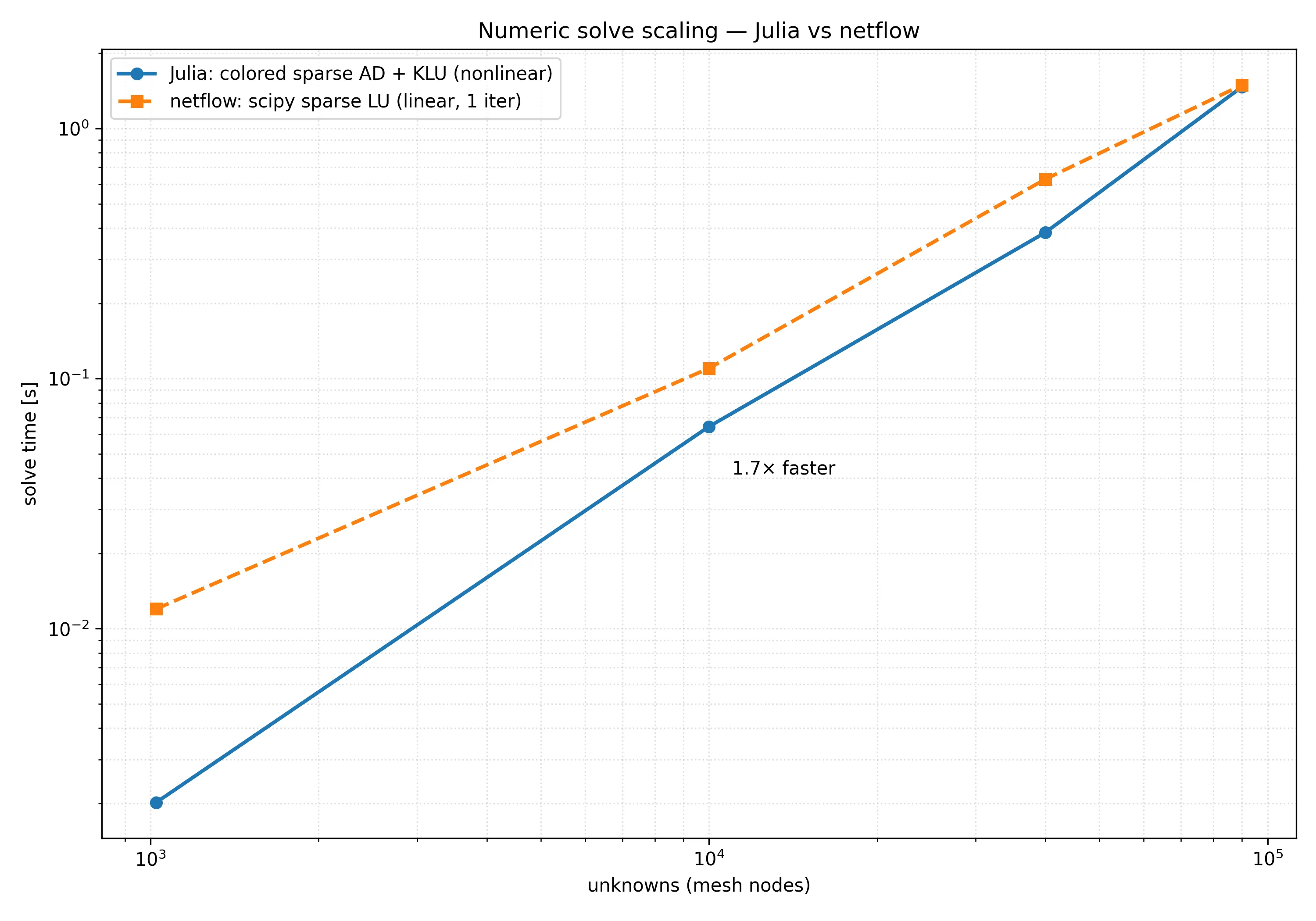
- Julia’s numerics matched or beat Python at scale — about 1.7× faster at 10,000 nodes and at parity by 90,000, which is conservative because the Julia version is solving a nonlinear problem where the Python one was solving the linearized version.
- Cross-domain composition is the real payoff. Wiring a reactor power model (where power depends on temperature, closing the feedback loop with fuel) into the thermal network was friction-free — exactly the kind of thing a hand-rolled solver makes painful.
The catch: the wall is code generation, not math
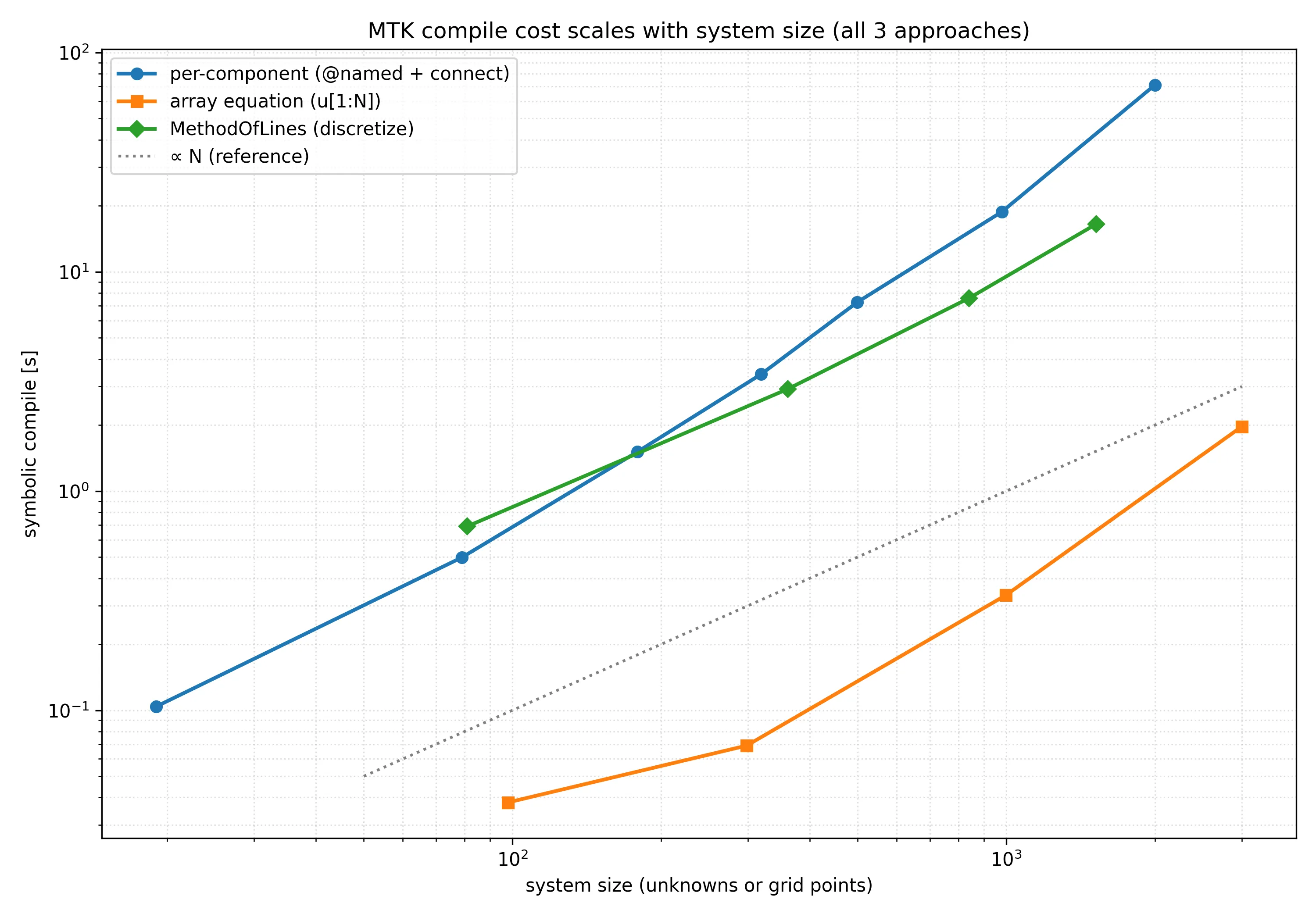
The numerics are great. What stops you isn’t the solver — it’s compiling the model. MTK’s compile step takes apart every connected component and turns the whole system into one large generated function. As the model grows, that compile time grows faster than the actual solve. Empirically it scales as roughly N^1.6 in the number of unknowns.
Extrapolating to a full 17×17 PWR fuel assembly (~40,000 unknowns) gave an estimated 25–40 minutes just to compile — before the simulator runs a single time-step. We never ran it.
The escape hatch exists: a tuned commercial compiler called JuliaSimCompiler.jl is known to flatten this scaling. But it’s gated behind a paid registry and was out of scope for an apples-to-apples standard-library comparison.
What MTK got right — at every problem size the open-source pipeline could reach, the answers were identical to what Modelica produced on the same physics. The paradigm is sound. The walls in this leg trace to ecosystem gaps — no built-in steam-table water properties for MTK, no fluid-flow connector in its standard library, and the tuned compiler being paid-only — not to anything wrong with the symbolic approach. That’s the spine of the capstone comparison.
All comparisons here are code-against-code, not validation against measured data.