netflow: hand-rolling a conservation-network solver in Python
·Devlog·2 min read— views
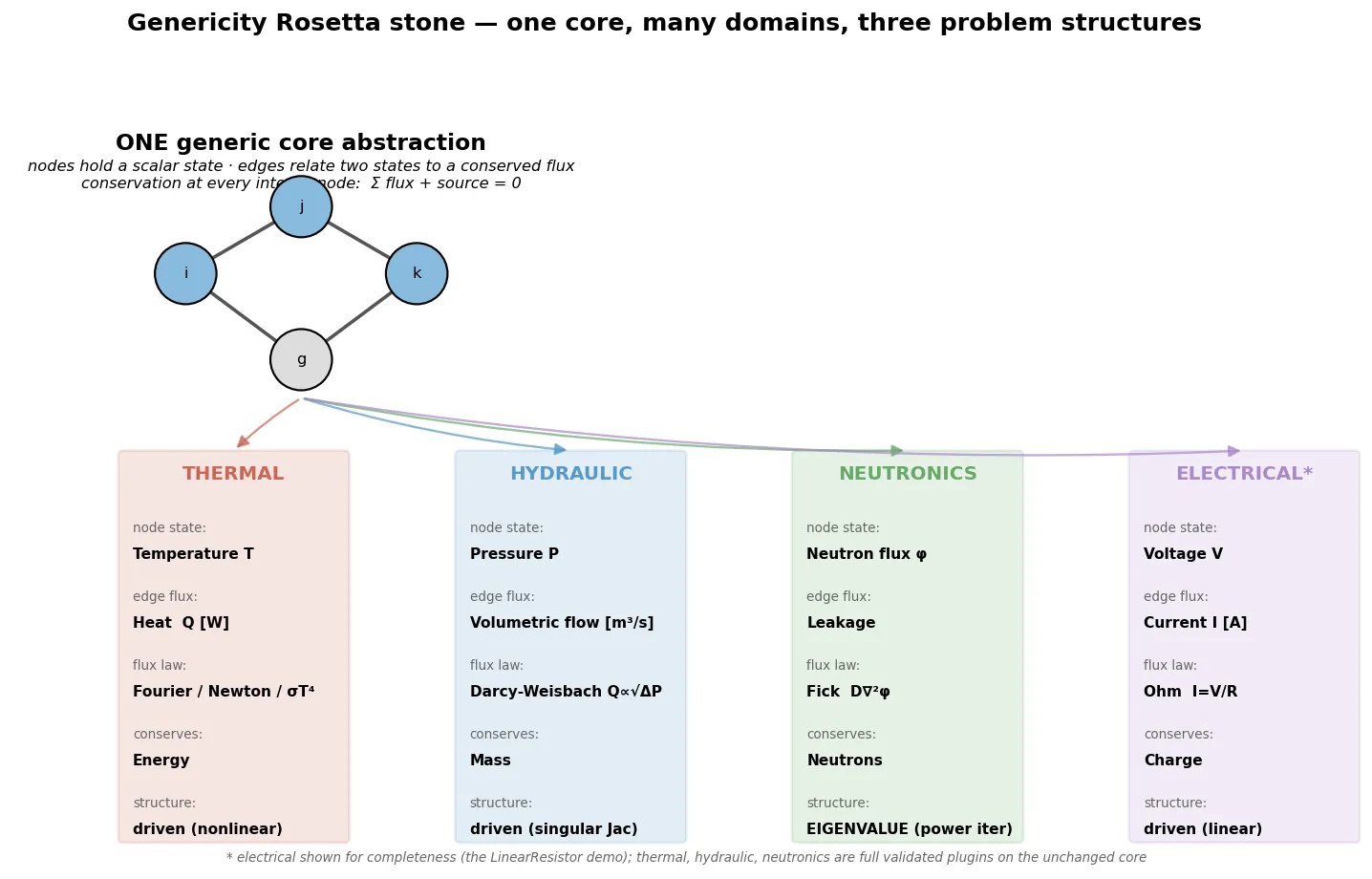
What it is. A general-purpose solver for one shape of physics problem: a value sits on each node of a network, and a conserved flow runs along each edge between them. Hot/cold temperatures across a fuel pin are nodes; heat flow between them is an edge. Same idea works for pressures and flow in a piping network, or for neutron populations across a reactor core.
It sits between raw scipy.sparse and full-blown engineering codes,
competing on Python ergonomics and cross-domain reach rather than depth.
Why. Most domain codes are locked to one physics. The bet was that a single generic core could host very different problems as plug-ins — fast enough to do early-design sizing and bounding (how hot can the fuel get? how big does the pipe need to be?) ahead of heavier simulators.
Highlights
- One core, four problem shapes. The same solver handles steady-state, time-varying transients, eigenvalue problems (like reactor criticality), and coupled multi-physics — each one just a different outer loop around the core. A second domain (hydraulic pipe networks) and a neutron-diffusion solver were added with zero core changes: genericity proven, not claimed.
- Exact where it counts. The fuel-pin radial model (water film, helium gap, cladding, fuel) reproduces the textbook closed-form answer almost exactly. The neutronics calculation converges at the expected rate as you refine the mesh.
- Honest about its edges. There’s no momentum equation in the core — pressure drop is a tabulated loss coefficient, and cross-stream mixing is a calibrated number, not solved physics. Knowing where the model stops being trustworthy is half its value.
A lesson worth keeping
Verification isn’t validation. Energy balanced to machine precision the whole time, yet the absolute fuel temperature only came out right after adding a physical heat-transfer term across the gap between fuel and cladding — a clean reminder that internal consistency isn’t the same as matching reality. Everything here is framed as code-against-code comparison, not validation against measured data.
The abstraction turned out to be the same “across / through” connector pattern that Modelica and ModelingToolkit already make mature — so netflow was frozen as a finished demonstrator and rebuilt the proper way, twice, under soul-test-netflow.