DSTF — Dynamic Systems Testing Framework
A backend-agnostic harness for regression-testing time-dependent system behavior — five simulators, six tolerance-based comparison modes, and an interactive report that doubles as the authoring surface for acceptance criteria.
Active·since — views
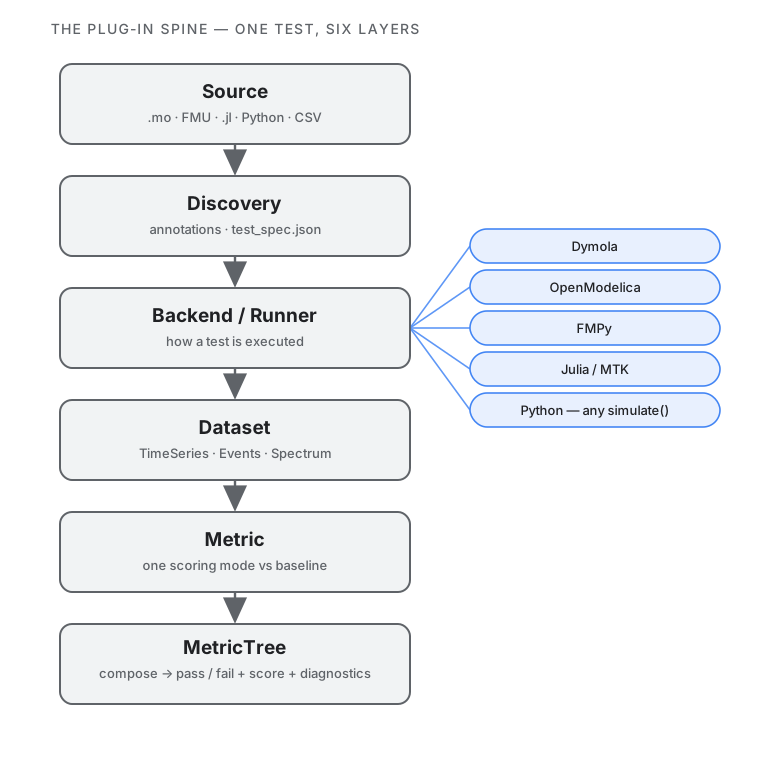
What it is. A Python framework for regression and unit testing of time-dependent system behavior (e.g., trajectories, FMU output, Modelica, Julia-MTK/Dyad, or experimental data). It discovers tests, runs each through whichever backend owns the model, compares the result against versioned baselines within customizable tolerances, and reports.
Multiple backends, one entry point
Each backend declares capability flags rather than being special-cased, with persistent-worker support where it pays off. These are the initial backends and can be extended to accommodate additional options.
| Backend | Source kind | Notes |
|---|---|---|
| Dymola | Modelica .mo |
Python interface; falls back to batched .mos |
| OpenModelica | Modelica .mo |
OMPython ZMQ; falls back to omc -s |
| FMPy | Pre-built FMU | fmpy.simulate_fmu in-process |
| Julia / MTK | .jl ModelingToolkit |
stdin-JSON pipe; the newer Dyad front-end is untested |
| Python | any simulate(stop_time, tol) -> dict |
scipy, pandas, a CSV loader, an HTTP call — anything |
A single testing.json is the entry point; the first simulators entry
whose binary exists wins, so the same config travels across machines without
per-OS forks.
Six comparison modes, composed into a MetricTree
You don’t assert float-equality on a solver trajectory — you score it. DSTF ships several modes and composes them into a tree.
| Mode | What it scores |
|---|---|
nrmse |
RMSE over signal range — the default |
tube |
Signal stays inside a constant or time-varying envelope around the reference |
points |
Per-point checks at declared times with an x-tolerance box and abs/rel y-tolerance |
range |
Scalar min/max bounds — baseline-free |
event-timing |
Match solver events against a declared list within per-event tolerance |
dominant-frequency |
FFT-peak matching against a declared peaks table — windowable |
Leaves combine with and / or / k-of-n / weighted / warn, can scope
to a time window, and target named baselines — so a verdict is a tree, not a
single equality check.
The baseline is the contract
Tolerances, mode choices, and per-variable overrides live with the
baseline, not in a side config that drifts out of sync. Accept a result as
the new reference (--accept) and its acceptance criteria travel with it.
References are partitioned on disk by backend and OS — the same library
legitimately produces slightly different numbers under different solvers, and
that’s a fact to record, not a bug to paper over. Each test carries up to
three baseline roles:
- primary — the regression anchor; can hard-fail. At least one scoring
leaf must target it outside a
warnwrapper. - soft-checks — imported foreign references, forced inside a
warnwrapper by the validator, so they flag drift but never fail the build. - companions — plot-only overlays (experimental CSVs, analytical solutions, vendor traces) that can never be scored against.
The report is the IDE
The interactive HTML report is the authoring surface for acceptance
criteria, not just a pass/fail readout. Shift-drag a tube envelope and the
verdict re-scores live in the browser; restructure the tree; tune a
frequency-peak table and watch the windowed FFT recompute. When you’re happy,
download an RFC 6902 JSON-Patch and apply it from the command line with
dstf spec-update. No server, no live-apply: the browser is where you
compose, the CLI is where you execute, and the patch is the handoff. A
scorer-parity suite runs the Python scorers and the JavaScript live-preview
scorers against the same fixtures and asserts they agree — because the worst
failure mode for a what-you-see-is-what-you-commit report is a UI that lies
about the verdict.
First run
The repo ships a demo library for each backend. The easiest first run is the Modelica demo:
uv run dstf --config examples/modelica/ModelicaTestingLib/Resources/ReferenceResults/testing.json runIt reads testing.json, discovers the demo tests, runs each in a persistent
simulator worker, partitions output under testing_output/ by backend + OS,
compares against the ref_NNNN.json baselines, and prints pass/fail. Add
--report ./reports for the interactive HTML reporter; --parallel N prints
a live dashboard URL that auto-refreshes.
Writing about this
A backend-agnostic harness for regression-testing time-dependent system behavior — five simulators, six tolerance-based comparison modes, and an interactive report that doubles as the authoring surface for acceptance criteria.