DSTF: regression testing for behavior that moves
·Devlog·5 min read— views
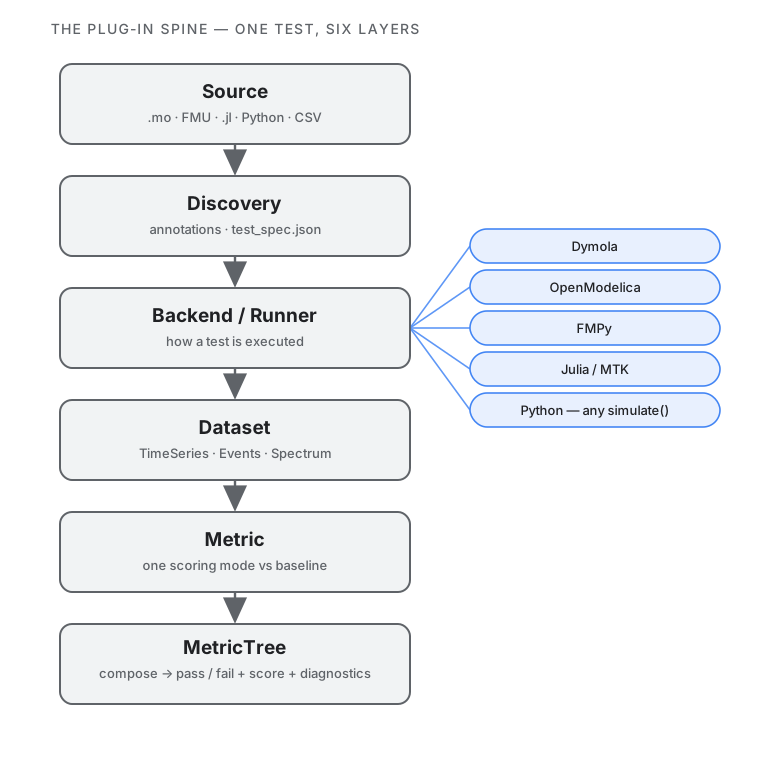
What it is. A Python framework for regression and unit testing of time-dependent system behavior — the kind of signal a simulator, an FMU, or a recorded test bench produces over time. It discovers tests, runs them through whichever solver owns the model, compares the resulting trajectories against versioned baselines, and reports. It does this across five very different ecosystems behind one CLI: Modelica (Dymola and OpenModelica), FMU (FMPy), Julia / ModelingToolkit, and arbitrary Python — Modelica is just the first consumer, not the reference model.
Why. You cannot unit-test a simulation the way you unit-test code. A
nonlinear solver run on two machines — or two solver versions, or two
backends — will not return bit-identical floats, and it shouldn’t have to.
assertEqual(0.034, 0.034) is the wrong question. The right question is
“does this signal match the stored reference, within the tolerances I care
about?” — and that question has many shapes. Sometimes it’s an error norm.
Sometimes it’s “stay inside this envelope.” Sometimes it’s “the third event
fires within 5 ms of where it used to.” Every modeling team I’ve watched
ends up rebuilding some ad-hoc version of this comparison machinery, badly,
for their one ecosystem. DSTF is the attempt to build it once, properly, and
make the ecosystem a plug-in.1
Highlights
-
Five backends, one entry point. Modelica via the Dymola Python interface or OpenModelica’s OMPython bridge; pre-built FMUs via FMPy; Julia models via a ModelingToolkit worker; and a Python backend that runs any
simulate(stop_time, tolerance) -> dict— scipy, pandas, a CSV loader, an HTTP call. A singletesting.jsonpicks the backend (the first one whose binary exists wins), so the same config travels across machines without per-OS forks. -
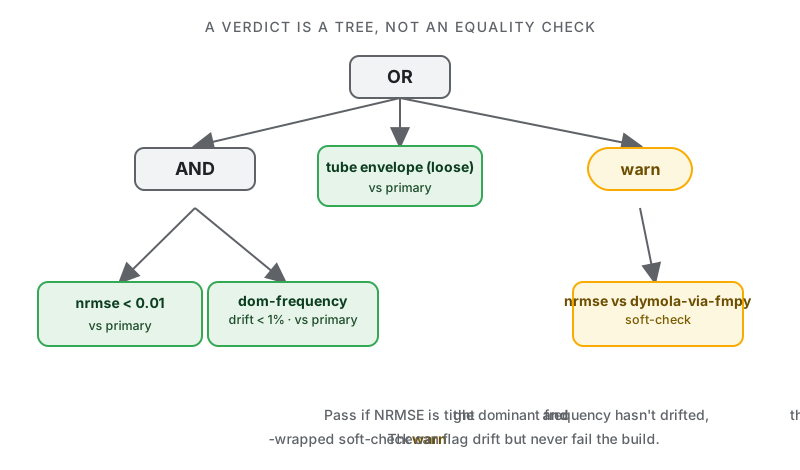
Six comparison modes, composable into a scoring tree.
nrmse(error over signal range),tube(stay inside a constant or time-varying envelope),points(checks at declared times with an x/y tolerance box),range(scalar bounds, baseline-free),event-timing(match solver events within a per-event window), anddominant-frequency(FFT-peak matching). Leaves combine withand/or/k-of-n/weighted/warnand can be scoped to a time window — so “pass if NRMSE is tight and the dominant frequency hasn’t drifted, or the loose tube holds” is a tree, not a special case.
-
The baseline is the contract. Tolerances, mode choices, and per-variable overrides are stored with the baseline, not in a side config that drifts out of sync. Accept a result as the new reference and its acceptance criteria travel with it. References are partitioned on disk by backend and OS, because the same library legitimately produces slightly different numbers under different solvers — that’s a fact to record, not a bug to paper over.
-
The report is the IDE. This is the part I’m most pleased with. The interactive HTML report isn’t just a pass/fail readout — it’s the authoring surface for acceptance criteria. Shift-drag a tube envelope and the verdict re-scores live in the browser; restructure the scoring tree; tune a frequency-peak table and watch the windowed FFT recompute. When you’re happy, you download an RFC 6902 JSON-Patch and apply it from the command line with
dstf spec-update. No local server, no live-apply: the browser is where you compose, the CLI is where you execute, and a patch is the clean handoff between them. -
Three baseline roles, kept honest. A test’s primary baseline is the regression anchor and can hard-fail. Soft-checks — say, another system’s reference imported for cross-comparison — are forced inside a
warnwrapper by the validator, so they can flag drift but never fail your build. Companions — experimental CSVs, analytical solutions, a vendor’s reference trace — are plot-only overlays that can never be scored against. The distinction sounds pedantic until the first time someone’s build goes red because a companion curve moved.
The catch: this is a regression tester, and stays one
The discipline that makes DSTF useful is mostly discipline about what it won’t do. It answers one question — does this signal match the reference within tolerance — and refuses to grow into the adjacent tools. It does not estimate parameters or calibrate models to fit data. It does not do root-cause analysis of why a test failed at the physics layer; it emits scores and diagnostics (max deviation, where, when) and hands those off to whatever tool you use for that. It is not a simulator and never re-implements a solver. There is no ML in the repo. Those are hard lines, and holding them is what keeps the core small enough to trust.
A few things are deliberately still partial. Cross-backend verification — running the same test through Dymola and an exported-FMU path and comparing — is wired as a capability but remains experimental: a forward bet, not a finished feature. Event-timing is the one comparison mode without a live in-browser preview; its event-pairing has too many tie-breakers to mirror faithfully in JavaScript, so it stays CLI-authoritative. The Julia backend works against ModelingToolkit; the newer Dyad front-end is untested. And a rule-based criterion recommender — a layer that would look at a fresh signal and propose a starter scoring tree — is designed but not built.
What’s solid is the spine: 837 passing tests as of the latest run (including roughly 70 browser-driven checks of the interactive report), five production backends, a demo library for each, and a parity test suite that runs the Python scorers and the JavaScript live-preview scorers against the same fixtures and asserts they agree — because the worst failure mode for a what-you-see-is-what-you-commit report is a UI that lies about the verdict.
If you build models that produce signals over time and you’ve ever copy-pasted a tolerance check between two test files, this is the tool I wish I’d had three projects ago.
Footnotes
-
“Behavior that moves” is the honest scope: anything time-dependent, whether it comes from a solver, an FMU, a native binding, or a recorded trace. The framework provides discovery, execution, baseline management, comparison, and review; the source of the behavior is a plug-in. ↩