Roster Rotation
A vanilla-JS PWA that generates fair youth-sports lineups — equal playing time first, a pure rotation engine, live sideline editing, season fairness stats, and an Android wrap from the same source. Offline, on your phone, data stays on the device.
Active·since — views
What it is. A web app tto help manage a fair lineup rotation for a youth sports team. Enter a roster, mark who showed up, pick a format — four quarters, two halves, a single game — and it produces a period-by-period lineup where every player plays as close to the same amount as the arithmetic allows. It installs to a phone’s home screen, works with no signal on the sideline, and keeps all its data on the device. No account, no server, no build step: plain HTML, CSS, and JavaScript served as a static site, with an additive Capacitor layer that wraps the same source into an Android app.
Why. “Everyone plays equal time” is the easiest promise a youth coach can make and the hardest to keep by hand. Kids miss games, some positions are scarce, and a parent is watching the clock for their kid specifically. Tracking all of that on a clipboard while also coaching is the actual problem. The app treats fairness as a scheduling problem with a clean optimum, and aims to be trustworthy enough to own that bookkeeping.
Fairness has a strict priority order
The rotation engine balances four goals, and the order is the design — each goal dominates the ones below it, so the engine never trades a player’s playing time for a preferred position.
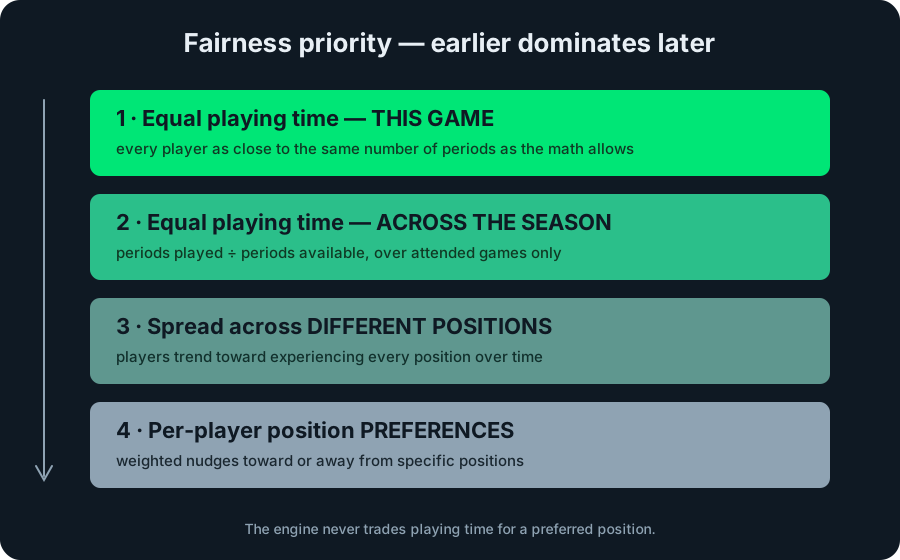
Season fairness (goal 2) is measured as periods played ÷ periods available, computed only over games a player actually attended. A kid who shows up to five games is treated exactly like one who shows up to ten — missing a game neither punishes nor rewards you. This absence neutrality is the single decision that makes the season stats feel fair to parents rather than arbitrary.
The lineup is a live document
After generating, the coach works the Lineup tab on the sideline:
- Tap two players in the same period to swap them — instantly, or with a time-fraction picker / exact stepper.
- Edit mid-game to add a late arrival or remove a player (injury, departure), with the rest of the game rebalancing automatically.
- Rebalance from any point forward with a per-period button to re-optimize the remainder.
- Track goals per player and per opponent period, with a running score bar, game labels, and notes.
- Position-colored timeline bars show each player’s time at each position; tap a bar for a full-game breakdown. Mark a game “Scrimmage” to exclude it from season stats.
Every edit saves immediately, so the season stats reflect what actually happened on the field, not what was planned.
Season stats
The Season tab has three views:
- Overview — games played, W-L-D record, roster size, average availability, goals for/against with differential, shutouts, and a playing-time chart.
- Games — an availability dot-chart with W/L/D letters and fairness coloring, plus game history with scores and fairness badges.
- Players — a per-player stats table, position distribution, and a goals chart.
Game-day constraints
Optional controls before generating a lineup: position pins (lock a player to a position), position stickiness (reduce changes between periods), a max periods-per-player cap, a per-position cap, and a max-subs-per-break limit (useful for large rosters). Defaults are configurable in Settings.
One field engine, several sports
A separate Field tab draws a to-scale pitch / court / rink / diamond as SVG, with draggable position dots, freehand route and zone drawing, a defensive overlay, and saved plays. It works standalone or synced with a game plan. Crucially, formations are visual only — they move dots around the field but never touch the rotation engine, so changing your shape can never break the fairness math or invalidate a stat.
Privacy is a design choice, not a gap
All data lives in the device’s local storage. Nothing is sent to any server, there is no account, and exported backups are local files you share deliberately. Fonts are self-hosted, so the app makes no third-party or runtime network calls — which is what lets it honestly disclose, to the Play Store and to parents, that it collects nothing.
*Live and installable at greenwoodms06.github.io/roster-rotation.
Writing about this
A vanilla-JS PWA that generates balanced youth-sports lineups — equal playing time first, with a pure rotation engine, live sideline editing, and an Android wrap from the same source.