Roster Rotation: fair playing time for youth sports, offline and on your phone
·Devlog·5 min read— views
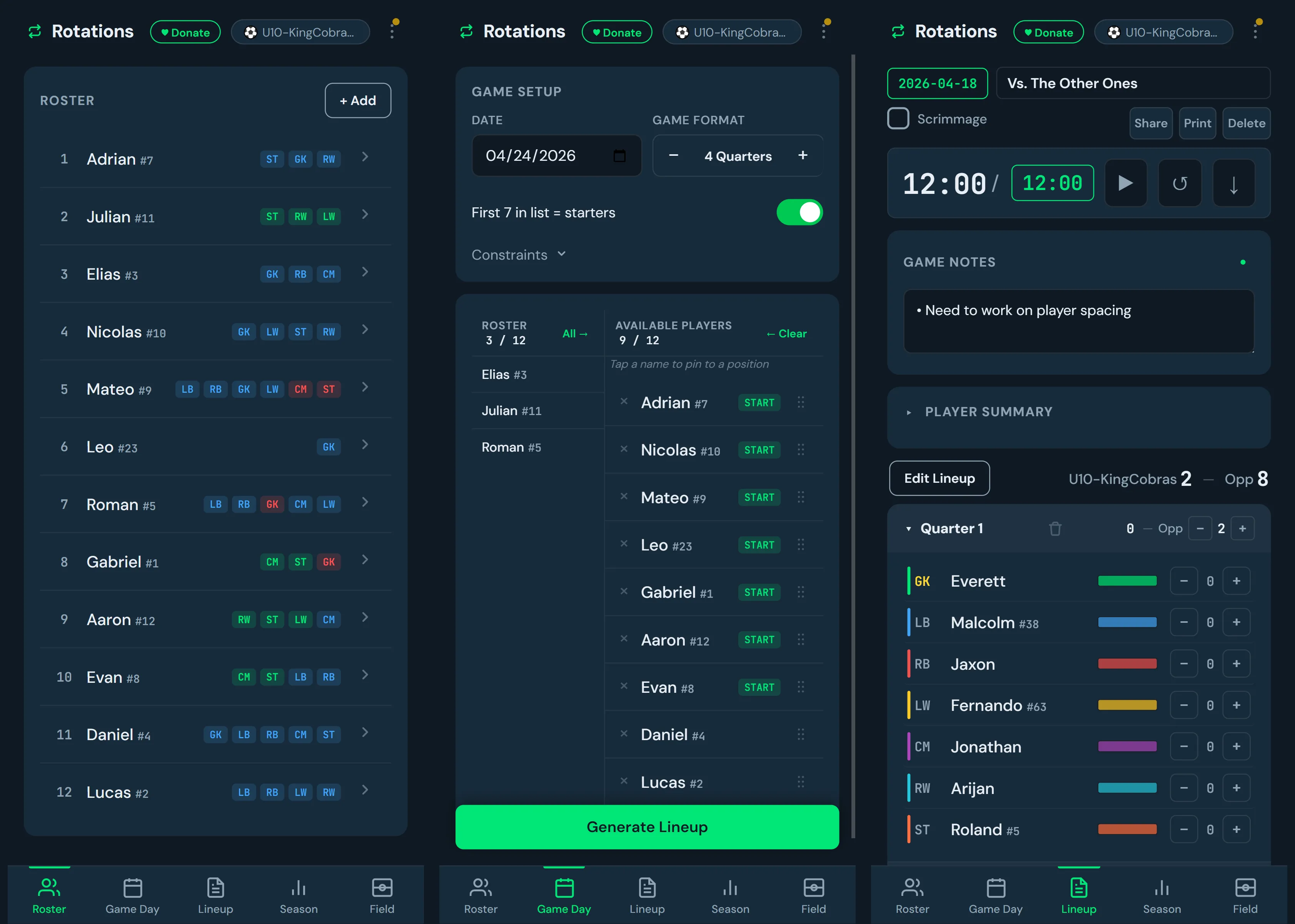
What it is. A web app that does one unglamorous job well: it builds a fair lineup rotation for a youth sports team. You enter a roster, mark who showed up, pick a format — four quarters, two halves, whatever — and it produces a period-by-period lineup where every kid plays as close to the same amount as the arithmetic allows. It runs in a browser, installs to a phone’s home screen, works with no signal on the sideline, and keeps all its data on the device. There is no account, no server, and no build step in the codebase — it’s plain HTML, CSS, and JavaScript served as a static site, with an additive Capacitor layer that wraps the same source into an Android app.
Why. “Everyone plays equal time” is the easiest promise a youth coach can make and the hardest to keep by hand. Kids miss games. Some positions are scarce. A parent is watching the clock for their kid specifically, and they will notice if Quarter 4 went sideways. Tracking all of that on a clipboard while also, you know, coaching, is the actual problem. The app’s bet is that fairness is a scheduling problem with a clean optimum, and that a coach should be able to trust the output enough to hand it the clipboard.
Highlights
-
Fairness has a strict priority order. The engine balances four things, and the order is the whole design: equal playing time this game comes first; equal playing time across the season second; spreading players across different positions third; and per-player position preferences last. Earlier goals dominate later ones, so the app never trades a kid’s playing time for the sake of giving someone their favorite position.
-
Fairness is a ratio, not a tally. Season fairness is measured as periods played ÷ periods available, computed only over games a player actually attended. A kid who shows up to five games is treated exactly like one who shows up to ten — missing a game neither punishes nor rewards you. This “absence neutrality” is the single decision that makes the season stats feel fair to parents rather than arbitrary.
-
Brute force, on purpose. Each period’s position assignment is solved by checking every permutation rather than reaching for the Hungarian algorithm. For a 9-position lineup that’s ~363,000 arrangements, which a phone clears in milliseconds; even an 11-a-side football lineup stays under a second. The payoff is code you can read top to bottom and an answer that is provably optimal, with zero matrix-library dependencies.
-
The lineup is a live document. After generating, the coach can tap two players to swap them, sub a kid off the bench, add a late arrival, or remove someone who got hurt — and the rest of the game rebalances around the change. Every edit saves immediately, so the season stats always reflect what actually happened on the field, not what was planned.
-
One field diagram engine, several sports. A separate Field tab draws a to-scale pitch / court / rink / diamond as SVG, with draggable position dots, freehand route and zone drawing, a defensive overlay, and saved plays. Formations are deliberately visual only — they move dots around the field but never touch the rotation engine, so changing your shape can never break the fairness math or invalidate a stat.
-
One codebase, two distribution channels. The PWA is the default target and ships to GitHub Pages untouched. A thin Capacitor wrap mirrors the same JS into an Android project for the Play Store — including a small native bridge for printing a lineup and the system share sheet for backups — without forking the source or adding a framework.
A lesson worth keeping
The most useful structural decision was separating hard guarantees from soft niceness, and refusing to let the second touch the first.
The hard layer decides how many periods each player gets — the equal-time-then-season-fairness arithmetic. Once that’s fixed, a second layer decides which periods, using tiebreakers that only ever fire when the hard layer is indifferent. Those tiebreakers do the things a coach would do by instinct: spread a kid’s two rest periods apart instead of benching them for the whole middle of the game, and give someone a breather after a long streak on the field. They make the lineup feel humane.
The temptation, every single time, is to let the nice-to-have leak upward — “just this once, let him sit an extra period so the rotation looks cleaner.” The discipline that paid off was making that structurally impossible: the spacing logic is mathematically incapable of changing anyone’s total playing time, because it only sorts within ties the fairness layer already declared even. A coach can override any individual decision by hand, but the engine cannot quietly trade fairness for tidiness. That boundary is the reason the output is trustworthy enough to hand someone a clipboard built from it.
It’s also honest about where it stops. The engine optimizes fairness, not winning — it has no notion of matchups, momentum, or specializing your best players late in a close game; that’s a different tool for a different kind of team. There’s no cloud sync, because the privacy answer the app wanted to give the Play Store was “this app collects nothing,” and the way you earn that answer is by genuinely sending nothing anywhere. Knowing which problems it deliberately doesn’t solve is half of what makes the one it does solve dependable.
Roster Rotation is live and installable at greenwoodms06.github.io/roster-rotation, and the full feature tour and design rationale live on the project page.