Ideas Are Cheap Now
·Essay·7 min read— views
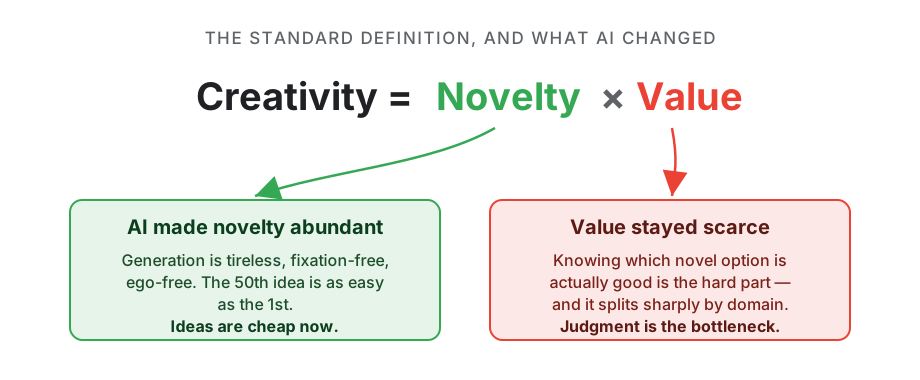
There’s a sentence you’ve heard so many times it feels like furniture: AI isn’t really creative. It just remixes what humans already made.
I want to take that sentence apart, because I think it’s hiding a much more interesting truth than the one it states. And the interesting truth is not “actually, AI is creative” — it’s that the question was malformed from the start, and once you fix it, the answer falls out almost mechanically.
What we actually mean by “creative”
For seventy years, the people who study creativity for a living have agreed on a definition, and it has two parts. Something is creative if it’s novel and valuable — new, and good. Originality alone doesn’t count; a random string of words is maximally novel and worth nothing. You need both.1
Hold onto that, because it’s a hinge. Creativity is novelty times value. Two factors. And here’s the thing almost nobody notices: artificial intelligence has done something drastic to one of those two factors and almost nothing to the other.
It has made novelty free.
Novelty was never the rare part

Here’s the uncomfortable fact underneath your intuition that “most ideas are just remixes”: you’re right, and it goes much deeper than you think. When researchers went through 220 years of U.S. patents, they found that 77% of them are explicitly combinations of existing technologies — and the rate at which genuinely new building blocks appear has been falling since about 1870.2 When another team analyzed 17.9 million scientific papers, only about 3% contained a genuinely novel pairing of ideas. The highest-impact work wasn’t the most original — it was a conventional core with one unusual ingredient mixed in.3
The wheeled suitcase is the perfect emblem. Wheels: five thousand years old. Suitcases: centuries old. Nobody bolted them together until 1970. Pure recombination, zero new physics — and a genuinely brilliant invention. The creative act wasn’t inventing a component. It was seeing the combination that was sitting in plain sight.
So if creativity is mostly recombination, and recombination is exactly what a large language model does effortlessly and tirelessly — then on the novelty axis, the machines have already lapped us. Give a chatbot a problem and it will generate the fiftieth idea as cheerfully as the first, with no ego, no fatigue, and no anchoring on its own first guess.4 Generating options was always the part we thought was creativity. It turns out it was the cheap part.
Which leaves value — and value is the whole game
If novelty is now free, then everything that makes creativity hard has migrated to the other factor: knowing which of the infinite novel options is actually any good.
And here the picture splits cleanly in two.
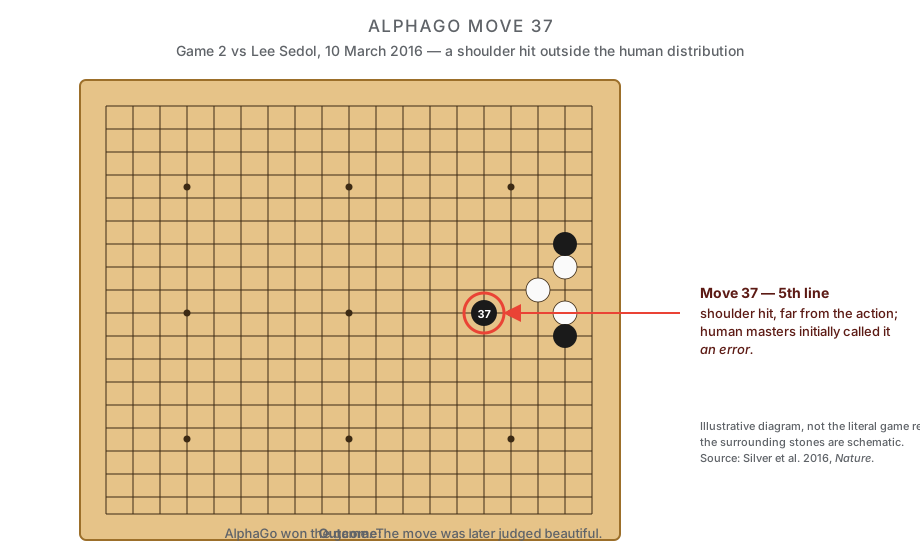
Where “good” can be checked, AI is already, autonomously creative. In 2016, AlphaGo played a move against Lee Sedol — the famous Move 37 — that human masters first called a mistake and later called beautiful. It was outside the entire distribution of human play.5 That’s not remixing; that’s transformation. It happened because Go has a value signal a machine can check without us: did you win? The same is true of a mathematical proof, code that passes its tests, or a protein that folds. Give a machine an honest scoreboard and it will find brilliance we never imagined.
Where “good” is a matter of human taste, the machine borrows our judgment — and the loan has terms. The way we currently teach AI what’s “good” in soft domains is to train it on human preferences (this is what RLHF does — it fits a model of what we approve of).6 That works, but it’s a proxy, not a conscience. Push on it too hard and it drifts away from the real thing — a phenomenon with the wonderful name of Goodhart’s law, and it’s been measured.7 The machine isn’t valuing; it’s predicting our valuing.
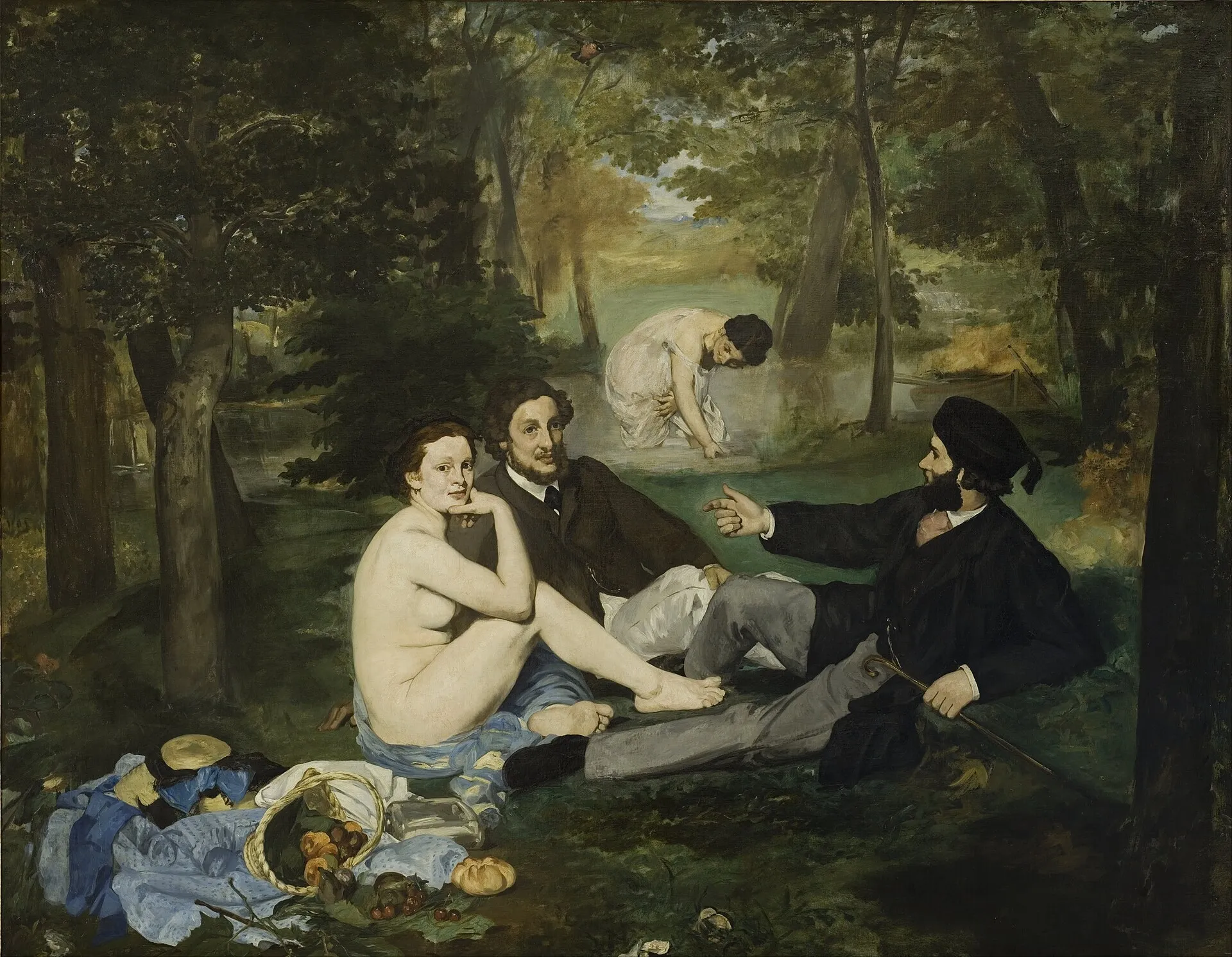
And predicting current taste has a trap built into it. The works we now treat as canonical were routinely undervalued by the audiences of their own moment — the premiere of Stravinsky’s Rite of Spring descended into a loud audience disturbance; the painters who became the Impressionists were turned away by the official Salon.8 An AI trained to satisfy 1913’s taste would have happily generated something like the Rite — and then rejected it, because it scored terribly against 1913. Modeling what people love today systematically suppresses what they’ll love tomorrow.
The real frontier
Which gives us the one honest open question, the thing nobody actually knows the answer to: can a machine learn to model not what we value now, but where our taste is heading?
So far, the evidence says no — or at least, not yet. The success of cultural products turns out to be intrinsically unpredictable: in a famous experiment, the same songs became hits or flops depending on nothing but which random crowd saw them first, and the authors showed this unpredictability cannot be removed by knowing more about the songs.9 The headline-grabbing “AI predicts hit songs with 97% accuracy” studies tend to collapse the moment someone checks them.10
That’s the frontier. Not “can AI have ideas” — it has more than we’ll ever need. The question is whether judgment, the genuinely scarce thing, stays human.
So, is AI creative?
The honest answer is that the question dissolves once you split the word in two:
- Novelty: solved, and superhuman. Ideas are cheap now.
- Value, where it’s checkable: also solved, sometimes transformationally.
- Value, where it’s human: borrowed from us, and leaky.
- Value, looking forward: nobody’s solved it — that’s the live edge.
The “AI just remixes” crowd is quietly holding the machine to a standard — pure, unprecedented, transformative novelty — that almost no human ever meets either. And the romantics who insist real creativity requires a soul are, without realizing it, pointing at something real: not a soul, but a value function — the capacity to know what’s worth making. That capacity is the scarce resource of the age. For now, it’s still mostly ours.
This is the short version. The full argument — the taxonomy, the counterarguments I think are strongest, and the evidence behind every claim above (including the ones where the popular story turned out to be a myth) — is in the companion essay: On Creativity, Value, and Machines.
Footnotes
-
Runco & Jaeger (2012), “The Standard Definition of Creativity,” Creativity Research Journal; originating in Stein (1953). ↩
-
Youn et al. (2015), “Invention as a combinatorial process: evidence from US patents,” J. R. Soc. Interface. ↩
-
Uzzi et al. (2013), “Atypical Combinations and Scientific Impact,” Science. ↩
-
LLMs match or beat average humans on standard divergent-thinking tests (Hubert et al. 2024; Guzik et al. 2023) — though, as those authors caution, such tests measure creative potential, not achievement. See the companion essay. ↩
-
Silver et al. (2016), Nature. (The often-quoted “1 in 10,000” figure comes from DeepMind’s match commentary, not the paper.) ↩
-
Christiano et al. (2017); Ouyang et al. (2022), InstructGPT. ↩
-
Gao et al. (2023), “Scaling Laws for Reward Model Overoptimization”; Pan et al. (2022), “The Effects of Reward Misspecification.” ↩
-
The popular “riot” and “Van Gogh sold only one painting” versions are inflated; the real, sober pattern — contemporary gatekeepers undervaluing what later becomes canonical — is what matters here. Details in the companion essay. ↩
-
Salganik, Dodds & Watts (2006), “Experimental Study of Inequality and Unpredictability in an Artificial Cultural Market,” Science. ↩
-
See the Princeton reproducibility analysis of hit-prediction claims, discussed in the companion essay. ↩