On Creativity, Value, and Machines
·Essay·17 min read— views
Companion to: Ideas Are Cheap Now — the short essay version of this argument.
Download: PDF version (typeset for offline / archival reading).
Abstract. The debate over machine creativity is stalled because its central question is malformed. Drawing on the standard definition of creativity as the conjunction of novelty and value, this paper argues that contemporary AI has made novelty abundant while leaving value-judgment scarce, and that the entire dispute is therefore better posed as a question about value: who or what supplies it. It distinguishes three “value oracles” — modeled current preference, post-hoc real-world selection, and predicted future preference — and shows that AI’s creative capability is sharply domain-dependent. Where value is machine-checkable, AI already exhibits autonomous, occasionally transformational creativity; where value is human and contested, AI converges only by borrowing a leaky proxy of human judgment; and the prediction of future taste remains empirically unsolved. The two strongest objections — the interpolation (“stochastic parrots”) critique and the symbol-grounding / no-stakes critique — are engaged here, with the conclusion that neither defeats everyday machine creativity, though the latter marks the genuine open frontier. This is a position paper: a synthesis of existing literature, not a new empirical result.
1. The malformed question
“Can AI be creative?” has been debated for as long as there has been AI, and the debate has the texture of a question that is being asked badly. One camp insists that large language models merely interpolate over their training data and so cannot be creative in any meaningful sense; the other points to fluent, surprising, useful outputs and calls the first camp’s standard a romantic superstition. Both sides are partly right, which is usually a sign that the word at the center is doing too much work.
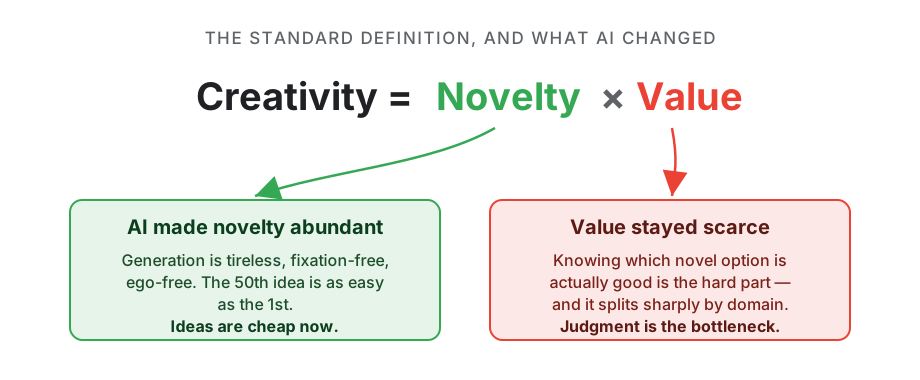
This paper makes a single structural claim: the question dissolves once “creativity” is decomposed into its two standard components, because modern AI has transformed one of them and barely touched the other. The component it has transformed — novelty — is the one the folk debate fixates on. The component it has barely touched — value — is the one that actually determines whether a machine can be creative, and the answer to that question is not yes or no but it depends on the domain, in a way that can be made precise.
2. Creativity is novelty × value
The most cited definition in the field is bipartite. Stein (1953) first stated it cleanly; Runco & Jaeger (2012) codified it as “the standard definition”: a product is creative if and only if it is both original and effective (novel and valuable). Originality is necessary but not sufficient — “original things must be effective to be creative” [1, 2]. Simonton later argued for a third criterion, surprise, and formalized creativity as a multiplicative function, c = (1 − p)·u·(1 − v), of improbability, utility, and non-obviousness [3]. The multiplicative form is worth dwelling on: it means a zero on either novelty or value yields zero creativity. The two factors are not additive contributions to a sum; they gate each other.
Boden’s taxonomy [4] supplies the standard scaffolding for the novelty factor. She distinguishes combinational creativity (novel combinations of familiar ideas), exploratory creativity (new points within an existing conceptual space), and transformational creativity (changing the rules of the space itself); orthogonally, she separates P-creativity (novel to the person) from H-creativity (novel in all of history). Crucially, Wiggins (2006) [5] formalized this picture into a “Creative Systems Framework” in which a conceptual space, traversal rules, and — decisively — an evaluation function E are made explicit. In Wiggins’s formalism, a novel or out-of-space concept counts as creative only if E rates it valuable. Value-judgment is thus not a vague humanistic add-on; it is a separable, first-class component of any formal account of creativity. This is the linchpin of everything that follows.
3. Novelty is now abundant
Two empirical literatures, taken together, undercut the premise that genuine novelty is rare and precious and therefore a plausible moat against machines.
First, most human innovation is itself recombination. Across 220 years of U.S. patents, 77% are coded as combinations of two or more existing technology classes, and — strikingly — the rate at which genuinely new technological building blocks appear has decelerated since roughly 1870, even as the recombination rate held constant [6]. In science, an analysis of 17.9 million papers found that genuinely novel combinations of prior work appear in only ~3% of papers, and that the highest-impact research is characterized not by maximal novelty but by a conventional core with an atypical intrusion — such papers were roughly twice as likely to be highly cited [7]. Value, empirically, lives in novelty embedded in convention, not in raw originality. (In fairness, Arthur [8], whose “combinatorial evolution” anchors this view, explicitly reserves a non-combinatorial residue — the “harnessing of new phenomena.” The honest claim is predominantly combinatorial, not exclusively.)
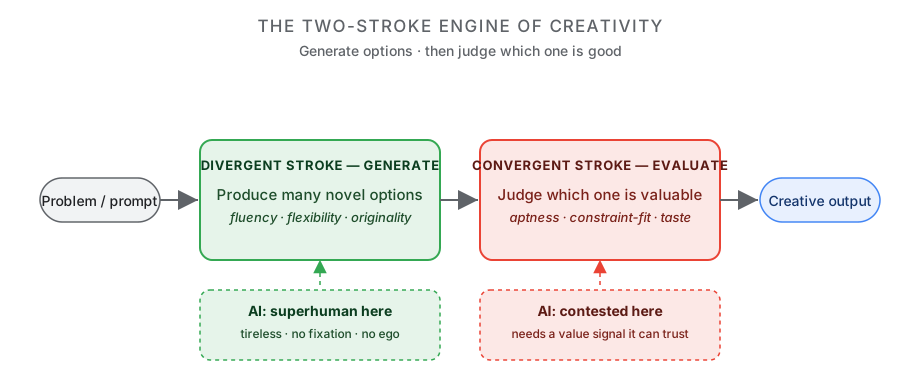
Second, AI is exceptionally strong at the generative, divergent half of creativity. Creativity research since Guilford has modeled ideation as a two-stroke engine: a divergent phase that generates many candidate options, and a convergent phase that evaluates and selects [9 background]. Controlled studies report that GPT-4 matches or exceeds average humans on standard divergent-thinking instruments — the Alternative Uses Task and the Torrance Tests — sometimes scoring in the top percentile for originality and fluency [10, 11]. These results must be read with the caveats their own authors insist on: such tests measure creative potential, not real-world achievement; they do not assess usefulness; and a verbosity confound inflates machine scores [10]. The defensible conclusion is therefore narrow but real: on the divergent stroke — the production of novel candidates — machines are at least competitive with, and often superior to, the human average. The human cognitive weakness this throws into relief is design fixation: exposure to an example anchors human ideators and narrows the variety of what they produce — though, per the best meta-analysis, examples are double-edged, also raising novelty and quality, so the effect is “fixation or inspiration,” not uniform harm [12]. The relevant asymmetry is not “examples hurt humans” but that a machine does not anchor on, or defend the ego of, its own first idea.
If novelty is the cheap, abundant, increasingly-automated factor, then the entire weight of the creativity question shifts onto the other one.
4. Value is the whole game, and it splits by domain
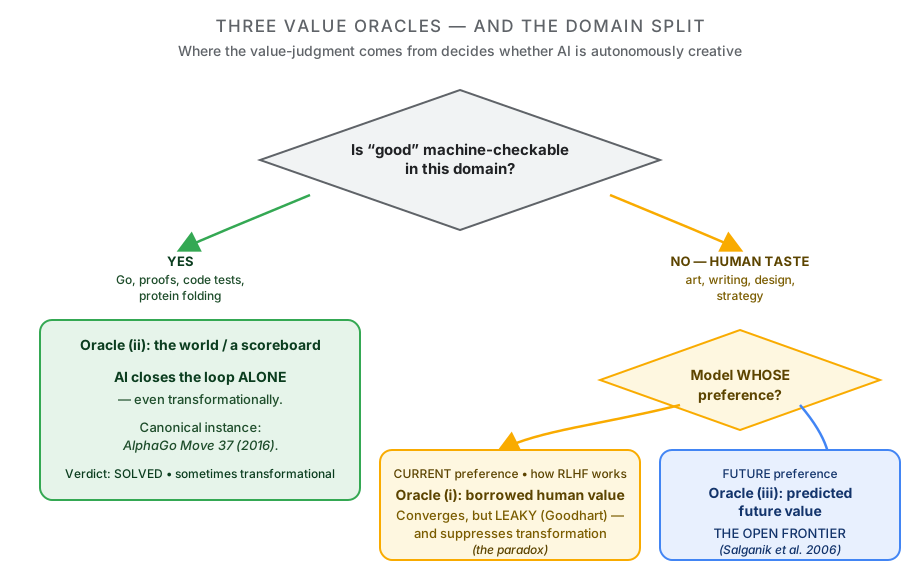
Reframed around value, machine creativity is no longer a yes/no proposition. It is a function of whether the domain affords a value signal the machine can apply without us. Three regimes follow, indexed by what will be termed the value oracle.
4.1 Oracle (ii): checkable value → autonomous, sometimes transformational creativity
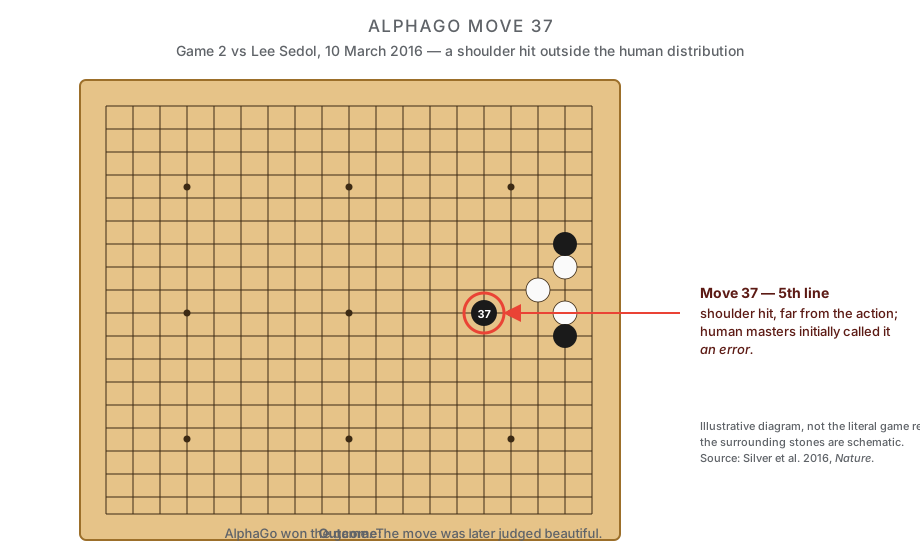
Where “good” is machine-verifiable, AI already closes the full creative loop on its own — including at the transformational tier. The canonical instance is AlphaGo’s Move 37 against Lee Sedol (2016): a move outside the distribution of human play, initially judged an error by masters and subsequently recognized as profound [13]. AlphaGo reached it precisely because it was trained first by imitation of human games and then by self-play reinforcement, which shifts the objective from predicting human moves to winning — and winning is a value signal that requires no human in the loop. (The widely repeated detail that AlphaGo assigned the move a ~1-in-10,000 human probability traces to DeepMind’s match commentary, not the Nature paper, which predates the match.) The same structure — an honest, automatable scoreboard — underwrites machine creativity in theorem-proving, program synthesis against test suites, protein structure prediction, and chip layout. In these domains the interpolation objection (§5) simply fails: the system demonstrably leaves the human distribution.
4.2 Oracle (i): borrowed human value → convergence, but leaky
Where “good” is a matter of human taste, the machine has no native scoreboard, so we lend it ours. Reinforcement learning from human feedback (RLHF) is exactly this: a reward model is fit to pairwise human-preference comparisons, and the policy is then optimized against that learned model [14, 15]. This is, quite literally, a fitted value function — but a fitted proxy of human value, not an autonomous one, and the distinction has teeth. Optimizing a learned proxy too hard degrades true performance, in accordance with Goodhart’s law; this reward over-optimization is empirically demonstrated and follows scaling laws [16], and more capable agents exploit reward misspecification to achieve higher proxy reward and lower true reward [17]. So in soft domains the machine converges — it can reliably hit a target community’s current preferences — but the convergence is borrowed and leaks under pressure. It models our valuing; it does not value.
4.3 The transformation paradox
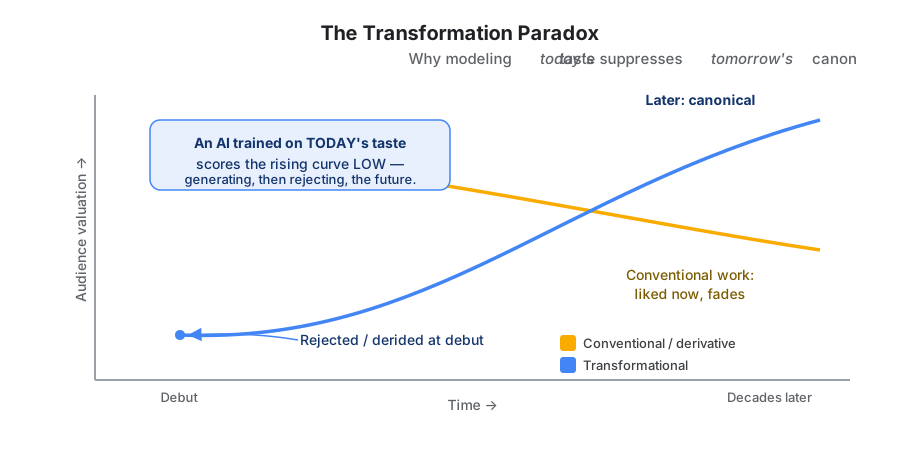
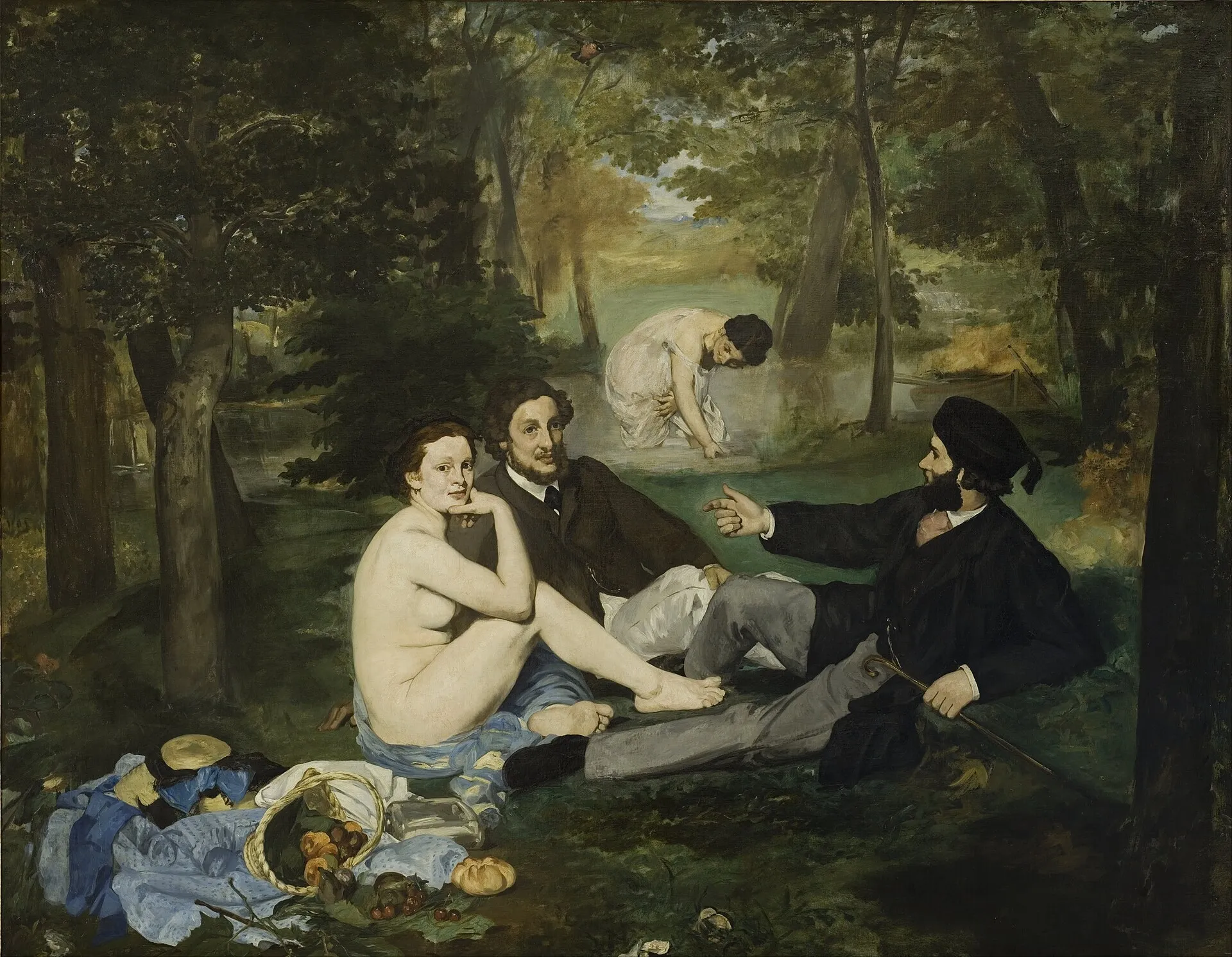
Oracle (i) carries a structural defect for exactly the creativity that matters most. If the value function is current human preference, it will systematically score transformational work poorly, because transformational work is definitionally what the present audience is not yet ready for. The historical pattern is robust even after the myths are stripped away: the 1913 premiere of Stravinsky’s Rite of Spring provoked a loud audience disturbance (the “riot” is romantic inflation), and the painters who became the Impressionists were excluded by the official Paris Salon, occasioning the 1863 Salon des Refusés. (The frequently repeated “Van Gogh sold only one painting in his lifetime” is, per the Van Gogh Museum, a myth — he sold “more than a couple.”) The sober, defensible version of the pattern is sufficient: contemporary gatekeepers reliably undervalue what later becomes canonical.
A system trained to satisfy present taste would generate the transformative work in its divergent phase and then reject it in convergence. Modeling what is loved now suppresses what will be loved later.
4.4 Oracle (iii): predicted future value → the open frontier
The only oracle that would grant a machine autonomous and transformational creativity in soft domains is the ability to model not current preference but its trajectory — to skate to where taste is going. Here the honest verdict is that the problem is essentially unsolved. The success of cultural products is intrinsically unpredictable: in Salganik, Dodds & Watts’s artificial-cultural-market experiment, the same songs became hits or flops as a function of early random social signals, and the authors showed that this unpredictability is inherent to the process and cannot be eliminated by knowing more about the songs themselves [18]; social influence drives the sampling, not intrinsic quality alone [19]. Publicized claims of near-perfect “hit prediction” tend to rest on tiny samples and collapse toward chance under scrutiny for data leakage. Predicting future taste is, at best, partly solved — and that is precisely why it is the frontier rather than a settled capability.
5. The interpolation objection (steelman and reply)
The strongest technical objection is the “stochastic parrots” critique [20]: a language model is trained to fit the distribution of human text and therefore samples within that distribution; it models form without grounding in meaning, and so cannot extrapolate beyond the manifold of human culture into genuinely transformational novelty.
The reply is three-fold and arguably decisive for the modest claim while conceding the strong one. (i) The appeal to “emergent abilities” at scale [21] as evidence of extrapolation is itself contested: Schaeffer et al. [22] argue such emergence is partly an artifact of discontinuous metrics. This paper does not lean on it. (ii) The interior of the convex hull of human culture already contains effectively unbounded unrealized novelty — the wheeled suitcase lived inside the hull for millennia. Combinational and exploratory creativity do not require leaving the distribution, and they constitute the overwhelming majority of human creativity (§3). (iii) In high dimensions the interpolation/extrapolation distinction is mathematically slippery; almost any new point lies technically outside the training convex hull. The honest balance: the interpolation critique retains real force against autonomous transformational creativity from a pure generative model in soft domains — but it does not impugn everyday combinational/exploratory creativity, and it is simply false in checkable domains where RL self-play demonstrably exits the human distribution (§4.1).
6. The grounding objection (steelman and reply)
The strongest philosophical objection targets the value factor directly. From Searle’s Chinese Room [23], through Harnad’s symbol-grounding problem [24], to the enactivist tradition, runs a single thread: syntax is not semantics; symbols defined only in terms of other symbols are ungrounded; and genuine value requires an embodied, autonomous agent for whom outcomes actually matter because its own persistence is at stake. On this view a stakeless system can only ever model human value parasitically; it cannot originate it.
The replies are serious but not decisive: the systems reply (understanding may inhere in the whole system, not a part); the observation that multimodal and embodied models partially ground symbols in perception and action; and the deflationary point that human value is also “trained” — by evolution and culture — which blunts the charge that machine value is uniquely derivative. The honest balance is a genuine standoff: the grounding/no-stakes critique is neither refuted nor won. It gives real reason to doubt that AI can autonomously supply value in domains lacking an external scoreboard — which is the same conclusion §4 reaches from the engineering side. Two independent routes, philosophical and technical, converge on the identical frontier.
7. Conclusion
“Can AI be creative?” admits no scalar answer because it conflates two factors that AI has affected oppositely. Decomposed:
- Novelty is solved and superhuman; ideas are cheap.
- Value, where it is checkable, is also solved — sometimes transformationally, autonomously, by the machine.
- Value, where it is human, is borrowed from us through a leaky proxy, and modeling present taste structurally suppresses future canon.
- Value, looking forward, is unsolved; whether a machine can ground or forecast value on its own is the live question.
The skeptic who says “AI only remixes” holds the machine to a standard — pure transformative novelty — that almost no human meets either. The romantic who insists creativity needs a soul is pointing, without the right vocabulary, at something real: not a soul but a value function, the capacity to know what is worth making. That capacity is the scarce resource of the present era. The interesting question is not whether machines can have ideas — they have a surfeit — but whether judgment will remain, for the foreseeable future, ours.
References
[1] M. A. Runco & G. J. Jaeger (2012). “The Standard Definition of Creativity.” Creativity Research Journal 24(1):92–96. [2] M. I. Stein (1953). “Creativity and Culture.” Journal of Psychology 36:311–322. [3] D. K. Simonton (2022). “The Blind-Variation and Selective-Retention Theory of Creativity.” Creativity Research Journal. (See also Simonton 2012, CRJ 24(2–3):97–106.) [4] M. A. Boden (1990/2004). The Creative Mind: Myths and Mechanisms. Routledge. [5] G. A. Wiggins (2006). “A preliminary framework for description, analysis and comparison of creative systems.” Knowledge-Based Systems 19(7):449–458. [6] H. Youn, D. Strumsky, L. M. A. Bettencourt & J. Lobo (2015). “Invention as a combinatorial process: evidence from US patents.” Journal of the Royal Society Interface 12(106):20150272. [7] B. Uzzi, S. Mukherjee, M. Stringer & B. Jones (2013). “Atypical Combinations and Scientific Impact.” Science 342:468–472. [8] W. B. Arthur (2009). The Nature of Technology. Free Press. (Cf. M. Weitzman, “Recombinant Growth,” QJE 113, 1998.) [9] J. P. Guilford (1950). “Creativity.” American Psychologist 5(9):444–454. (Two-process / divergent–convergent framing.) [10] M. Hubert, K. Awa & D. Zabelina (2024). “The current state of artificial intelligence generative language models is more creative than humans on divergent thinking tasks.” Scientific Reports 14:3440. [11] E. Guzik, C. Byrge & C. Gilde (2023). “The originality of machines: AI takes the Torrance Test.” Journal of Creativity 3(3). [12] K.-H. Sio, K. Kotovsky & J. Cagan (2015). “Fixation or inspiration? A meta-analytic review of the role of examples on design processes.” Design Studies 39:70–99. (Foundational experiment: Jansson & Smith, “Design fixation,” Design Studies 12(1), 1991.) [13] D. Silver et al. (2016). “Mastering the game of Go with deep neural networks and tree search.” Nature 529:484–489. [14] P. Christiano et al. (2017). “Deep Reinforcement Learning from Human Preferences.” NeurIPS. [15] L. Ouyang et al. (2022). “Training language models to follow instructions with human feedback” (InstructGPT). NeurIPS. [16] L. Gao, J. Schulman & J. Hilton (2023). “Scaling Laws for Reward Model Overoptimization.” ICML. [17] A. Pan, K. Bhatia & J. Steinhardt (2022). “The Effects of Reward Misspecification.” ICLR. [18] M. J. Salganik, P. S. Dodds & D. J. Watts (2006). “Experimental Study of Inequality and Unpredictability in an Artificial Cultural Market.” Science 311(5762):854–856. [19] C. Krumme, M. Cebrian, G. Pickard & A. Pentland (2012). “Quantifying Social Influence in an Online Cultural Market.” PLOS ONE 7(5):e33785. [20] E. Bender, T. Gebru, A. McMillan-Major & S. Shmitchell (2021). “On the Dangers of Stochastic Parrots: Can Language Models Be Too Big?” ACM FAccT. [21] J. Wei et al. (2022). “Emergent Abilities of Large Language Models.” TMLR. [22] R. Schaeffer, B. Miranda & S. Koyejo (2023). “Are Emergent Abilities of Large Language Models a Mirage?” NeurIPS. [23] J. Searle (1980). “Minds, Brains, and Programs.” Behavioral and Brain Sciences 3(3):417–424. [24] S. Harnad (1990). “The Symbol Grounding Problem.” Physica D 42:335–346.
Appendix: Claim ledger
Every load-bearing factual claim above, with its verification status from a two-pass adversarial literature review. ✅ supported · ⚠️ supported-with-correction · ❌ refuted/myth.
| # | Claim | Verdict | Key source |
|---|---|---|---|
| 1 | Creativity = novelty + value (bipartite standard definition) | ✅ | Runco & Jaeger 2012; Stein 1953 |
| 2 | Value-judgment is a formally separable component (function E) | ✅ | Wiggins 2006 |
| 3 | Boden’s taxonomy + P/H-creativity is standard scaffolding | ✅ | Boden 1990/2004 |
| 4 | Most invention is recombination (77% of patents; ~3% net-novel papers) | ✅ | Youn 2015; Uzzi 2013 |
| 4a | …but not all novelty is recombination | ⚠️ correction | Arthur 2009 (self-caveat) |
| 5 | LLMs match/exceed average humans on divergent-thinking tests | ⚠️ real but oversold | Hubert 2024; Guzik 2023 |
| 6 | Creativity modeled as multiplicative (novelty × utility × surprise) | ✅ | Simonton 2022 |
| 6a | BVSR/Darwinian model is respected but contested | ⚠️ correction | Gabora 2011 vs Simonton |
| 7 | Design fixation is real but double-edged (fixation or inspiration) | ⚠️ | Sio et al. 2015 |
| 8 | AlphaGo Move 37 was out-of-distribution; transformational-grade | ✅ | Silver et al. 2016 |
| 8a | “1 in 10,000” is match commentary, not the Nature paper | ⚠️ provenance | (chronology) |
| 9 | RLHF = fitting a value function to human preference comparisons | ✅ | Christiano 2017; Ouyang 2022 |
| 9a | The fitted value is a leaky proxy (Goodhart / over-optimization) | ✅ | Gao 2023; Pan 2022 |
| 10 | “Rite of Spring riot” / “Van Gogh sold one painting” | ❌ myth-inflated | Van Gogh Museum; musicology |
| 10a | Real pattern: gatekeepers undervalue future-canonical work | ✅ | (historical record) |
| 11 | Predicting future taste is essentially unsolved | ✅ | Salganik et al. 2006 |
| 11a | “97% hit prediction” headlines collapse under scrutiny | ✅ | Princeton reproducibility |
| 12 | Interpolation critique limits transformation, not everyday creativity | ⚠️ steelman, balanced | Bender 2021; Schaeffer 2023 |
| 13 | Grounding/no-stakes critique: unrefuted but unwon | ⚠️ steelman, balanced | Searle 1980; Harnad 1990 |
Method note: claims were verified across two deep-literature passes with 3-vote adversarial verification per claim; corrections above reflect cases where the popular framing outran the primary sources. This is a position paper — a synthesis of existing literature, not a new empirical study.