GoNoGo
A modular prerequisite-evaluation (checklist) plugin for Unreal Engine — define sets of conditions that must be satisfied, in any order, grouping, or timing, before a game event fires. Genre-agnostic; works with C++ and Blueprints. Ships a five-station launch-demo.
Active·since — views
What it is. An Unreal Engine plugin for checklists — broadly construed. A checklist is just a set of conditions that have to be satisfied before a game event fires, and once you say it that way, the same plugin handles quest prerequisites, crafting recipes, safety/launch sequences, timed challenges, and hierarchical mission trees.
Why. Every team building a non-trivial game eventually rolls their own checklist code, and it always ends up entangled with how the conditions combine (all of these? any 3 of 5? in order?), how time bounds get enforced, and what each “condition” actually represents. GoNoGo separates those three axes cleanly so you don’t have to.
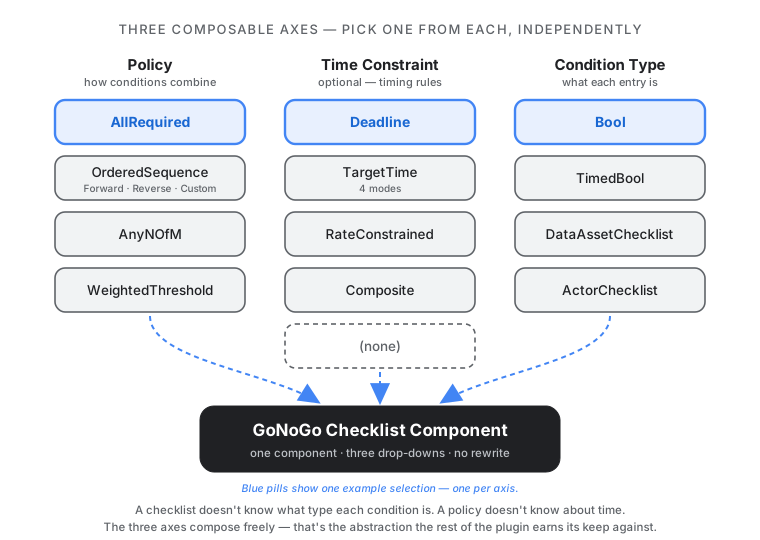
The architectural punchline — three composable axes
| Axis | Options |
|---|---|
| Policy — how conditions combine | AllRequired · OrderedSequence (Forward/Reverse/Custom) · AnyNOfM · WeightedThreshold |
| Time constraint (optional) — timing rules | Deadline · TargetTime (4 modes) · RateConstrained · Composite |
| Condition type — what each entry represents | Bool (simple flag) · TimedBool (per-condition deadline) · DataAssetChecklist (nested sub-checklist) · ActorChecklist (observe external actor) |
A checklist doesn’t know what kind of condition each entry is. A policy doesn’t know about time constraints. The three axes compose independently — and that’s the abstraction the rest of the plugin earns its keep against.
What it does well
- Mix the axes freely. “All required, but only if completed within 60 seconds, where 3 of the items are themselves sub-checklists” is one component plus three drop-downs, not a rewrite.
- Three setup paths, same plugin. Inline editor properties for the simplest case; DataAssets for shared/templated checklists across many actors; runtime C++ when you need full control. The component swaps between them transparently.
- Async Blueprint nodes.
Wait for Checklist ResolvedandWait for Condition Stateare latent nodes that fit the same idiom as UE’sDelay— drop them into a graph, no boilerplate. - Save / restore that respects hierarchy. A checklist with nested sub-checklists serializes recursively, and replay on restore suppresses external delegates so gameplay listeners don’t fire as if the events were happening live.
- DataAsset validation at edit time. The validator catches null policies, duplicate condition IDs, impossible AnyNOfM thresholds, phantom IDs in custom orderings, and transitive cycles through nested DataAsset references. Invalid assets show red in the Content Browser before they break runtime.
How a checklist resolves
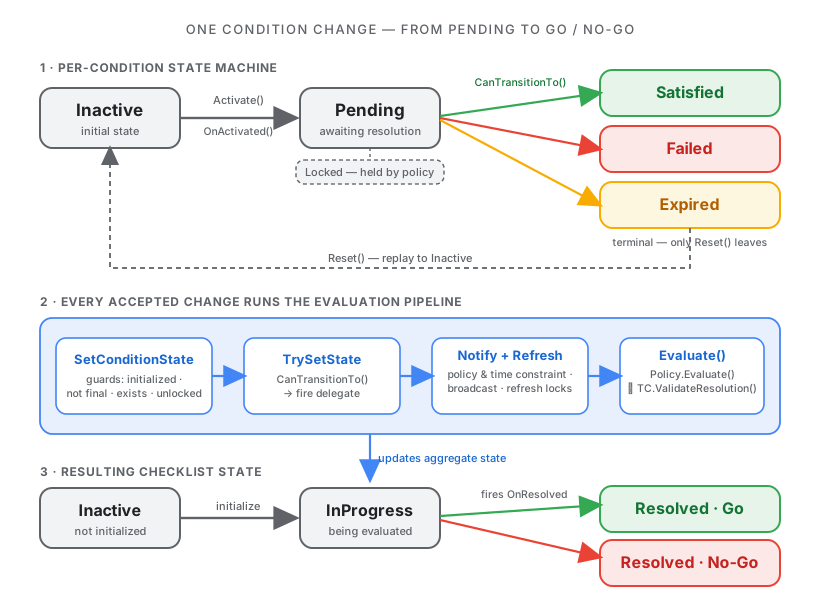
Each entry is a little state machine — Inactive → Pending → Satisfied / Failed / Expired — and every accepted change runs the same evaluation
pipeline: notify the policy and time constraint, refresh locks, then
Evaluate() (the policy proposes a result, the time constraint gets to
veto it). That single pipeline is what turns individual condition changes
into the checklist’s aggregate Go / No-Go.
The launch-demo
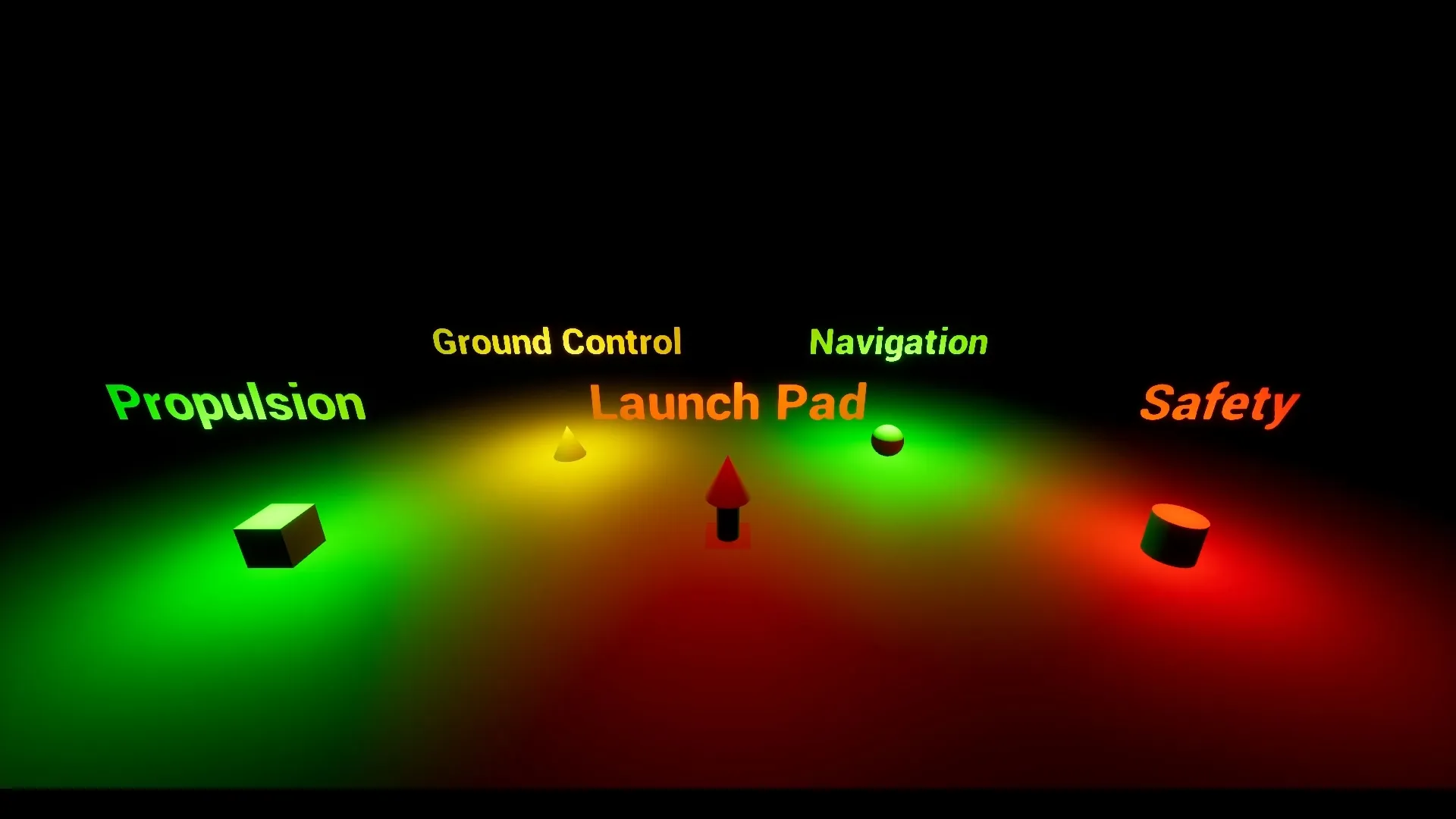
GoNoGo ships with a multi-station launch sequence that exercises every major feature through a realistic two-attempt scenario. Five self-contained station actors — Propulsion, Navigation, Safety, Ground Control, Launch Pad — each own their own checklist. A director actor orchestrates the sequence with 32 assertions.
- Attempt 1 progresses through Propulsion and Navigation cleanly, but Safety fails (weather + tracking both go down, dropping below the 3-of-4 threshold) → master No-Go → scrub.
- Attempt 2 resets everything and runs clean → launch.
Extending
GoNoGo is designed to be extended. Three extension points, each a single subclass:
- New condition type — subclass
UGoNoGoCondition. OverrideCanTransitionTo(),OnActivated(),CheckTimeConstraint(). - New policy — subclass
UGoNoGoEvaluationPolicy. ImplementEvaluate()(required), override the lifecycle hooks as needed. - New time constraint — subclass
UGoNoGoTimeConstraint, overrideOnActivated()/CheckTimeConstraints()/ValidateResolution(). - Custom time source — implement
IGoNoGoTimeSourceand inject viaSetTimeSource()(so deterministic-time tests and replay can drive the clock manually).